Timeline
La historia completa: lanzamientos, quiebras, inventos y momentos clave de la industria, década a década.
Mostrando eventos 251–500 de 5387.
 Texas Instrument SR-50A
 Tomy Blip
Tomy Space Turbo
Tornado Fighter
Tronica Brave Firemen
Tronica Clever Chicken
Tronica Shuttle Voyage
Tronica Thief In Garden
Tronica Treasure Island
Twinvader
UFO invaders
Unimex PinBall
 Valtoy Electric Tennis
Valtoy Electric Tennis blanco
Valtoy Futbol y Tennis Electric
 Video Action VA-I arcade
Video Action VA-II
Universal Research Labs (URL) empezó en el mercado de los videojuegos en 1973, cuando Allied Leisure los contrató para fabricar las placas d… ver más
Universal Research Labs (URL) empezó en el mercado de los videojuegos en 1973, cuando Allied Leisure los contrató para fabricar las placas deljuego Paddle Battle, una versión licenciada del Atari Pong. Además crearon el árcade Video Action, modelo VA-I, con forma de mesa octogonal. URL se encontró con millones de dólares en componentes electrónicos en sus almacenes tras la desaparición de Allied Leisure y otra serie de problemas financieros. Así, uno de sus fundadores decidiço embarcar a la empresa en el mercado de consumo, sacando en 1975 el Video Action model VA-II. Hubo dos variantes, una con un TV y monedero para colocarlo en los bares, y otra para uso en los hogares que podía conectarse a cualquier televisión. Dado su alto precio (solo la placa base pasaba de los 200$) solo tuvo éxito la versión para los bares, que podía rentabilizarse. La versión de hogar se había anunciado en navidad de 1974 por 550$.
Video Action VA-II Board
 Videomaster Home TV Game MKII VM577
Still sold as model VM 577, this second version of the 1974 Videomaster Home T.V Game uses the same electronic board, but housed into a nice… ver más
Still sold as model VM 577, this second version of the 1974 Videomaster Home T.V Game uses the same electronic board, but housed into a nicely redesigned metal case with bronze finish (a more robust solution the original and fragile plastic case). The power switch has been moved from the top side to the front side where the controllers plug. The system was hand assembled like the initial version. It is unknown if it was available as a kit. Moreover, the serial sticker did not stick well to the bottom side and is almost always lost. One of our specimens indicates 10 095, wich gives an interesting idea of how many specimens of the first model were made: up to 10 000.
Videomaster Home TV Game MKIII VM3
Tercera version ver más
Tercera version
Videomaster Home TV Game VM577
Videomaster Olympic Home TV Game
Videomaster Rally Home TV Game
Videomaster Shooting Star
 Videomaster Star Chess
Videomaster Superscore
Vtech Cops Chase
Waco Electro TicTacToe
 APF TV Fun 401A
Además de Atari y Sears, otras compañias estaban interesadan en distribuir una versión doméstica de la máquina Pong, APF Electronics, Inc. … ver más
Además de Atari y Sears, otras compañias estaban interesadan en distribuir una versión doméstica de la máquina Pong, APF Electronics, Inc. El primer clon lanzado por APF en 1976 fue APF TV Fun,siendo el primer sistema en utilizar el Pong-On-A-Chip AY-3-8500 de General Instrument, que a continuación permitió a cientos de empresas competir con el pong de Atari. Desafortunadamente, APF fue incapaz de igualar el éxito Atari, y la producción de la línea de APF TV Fun de consolas fue de corta duración. Los modelos 401, 401A y Sportsarama comparten la misma carcasa hexagonal en plástico simulando madera, con dos potenciómetros, uno a cada lado, para controlar el juego, metalizados. En la zona superior hay otra placa metalizada con 3 interruptores (encedido/apagado, seleccionar opciones del juego y modo de servicio. Un dial central selecciona el tipo de juego, y a cada lado de él hay dos pulsadores, uno de RESET y otro para servir la bola. Variaciones: Model 401A Model 442 Model 444 Model 405 Model 406
 Adman Grandstand Video Entertainment Computer
 Allieds Name Of The Game
Allieds was a well known company based at Hialeah in Florida who entered the arcade video game business in 1973 by being Ataris first licenc… ver más
Allieds was a well known company based at Hialeah in Florida who entered the arcade video game business in 1973 by being Ataris first licencee. Their Paddle Battle game was quite successful. The company also manufactured pinball machines, but started suffering from service problems in mid-1976. The pinball machines sales decreased significantly, so much that Allieds decided to enter the home video game market. Moreover, 1976 was the right year to do so as dedicated pong chips developed by General Instruments and MOS Technologies were extremely successful. Not only they avoided designing the game circuitry itself, thus allowing any technician to build his own game with very few parts, but they were also very affordable. Allieds received significant orders from several important customers, totalizing around 60,000 units. However, they did not forecast two obvious problems: the video game chip availability, and the (difficult) FCC approval. Being approved was the last (but mandatory) authorisation to market video games that met the regulations, and back in 1976, only three agents were allowed to perform the FCC tests in the USA. Consequently, the demand was very high and any fail would simply delay the game availability by several weeks. This proved to be fatal to many small manufacturers whose games never saw the light of the day. Others would simply loose some money by having many orders cancelled, which is what happened to Allieds. Although they did not fail the FCC tests, their approval was obtained in December 1976, two months later than expected. Not a good news knowing that the best moment to sell home video games is Christmas, only two or three weeks after being FCC approved... As a result, Allieds sold for around $350,000 of home consoles only, yet their business plan expected three times this amount, hence a large stock of unsold units. Even worse: the two-month delay finally resulted in over $3 million of cancelled orders. Allieds had planed a self productikon of 25,000 units, of which around 17,000 were built and around 13,000 sold until late 1977. Moreover, the market had completely soften due to the huge competition and price drops. Still, Allieds grossed around $670,000 and only had around 1000 unsold units at the end of the fiscal year. This, however, was a true performance. Other manufacrturers like Executive Games found themselves with much more unsold units. Allieds finally got rid of the remaining units at $15 each. The Company released only two models in 1976: Name Of The Game (model A-100) and Name Of The Game II (model A-300). Both played the same four games, but the former allowed up to four players, while the later was for only two players. Both used Mosteks MCS-7600-001 game chip (this chip was made in white ceramic package, whereas its later version, the MPS-7600-001, was made in a plastic package, hence the thought about the second letter calling for the package type: C for Ceramic and P for Plastic). As both systems were released in limited quantity, they became quite rare (the second model is even rarer). What makes them unique is their design. Darth Vader would have certainly enjoyed trying the first one when not fighting... One intelligent feature of these systems was their integrated switch-box, which also served as power switch. Thus, the TV antenna was directly connected to the system, which then connected to the TV through the antenna terminals. The only backdraw was the need ot keeping the game near the TV, unless an external switch-box was used to allow disconnecting the system.
Allieds Name Of The Game II
 Apple I
El Apple I fue uno de los primeros ordenadores personales, y el primero en combinar un microprocesador con una conexión para un teclado y un… ver más
El Apple I fue uno de los primeros ordenadores personales, y el primero en combinar un microprocesador con una conexión para un teclado y un monitor. Fue diseñado y fabricado a mano por Steve Wozniak, originalmente para uso personal. Un amigo de Steve Wozniak, Steve Jobs, tuvo la idea de comercializarlo. Fue el primer producto de Apple, presentado en abril de 1976 en el Homebrew Computer Club en Palo Alto, California
 Atari C010073-01
Atari C010073-3
Atari C011500
 Atari Hockey Pong
Atari Pong
Máquina identica a la Sears Telegames Pong, pero ya vendida con el logo de Atari. Modelo C-100 Juegos 1 Jugadores 2 ver más
Máquina identica a la Sears Telegames Pong, pero ya vendida con el logo de Atari. Modelo C-100 Juegos 1 Jugadores 2
Atari Pong Doubles
Atari Pong Prototype
Atari Super Pong
Modelo C-140 Juegos 4 Jugadores 2 ver más
Modelo C-140 Juegos 4 Jugadores 2
Atari Super Pong Ten
 Auto Race
Clon del Matel Auto Race ver más
Clon del Matel Auto Race
 Auto Race euro
Auto Race french
Auto Race japan
 BMC Video Game TVG-5000
 Beam Gun Duck Hunt
 Binatone TV Gaming Unit 01-4990
Binatone, empresa británica, tuvo un relativo éxito en la comercialización de sus máquinas en toda Europa. Este pong es similar al Entex Ga… ver más
Binatone, empresa británica, tuvo un relativo éxito en la comercialización de sus máquinas en toda Europa. Este pong es similar al Entex Gameroom Tele-Pong (USA). No dispone de contador en pantalla, pero sí uno manual en la propia máquina. La diferencia básica entre los modelos serie Master y el resto, es que estos primeros son en blanco y negro. TV GAMING UNIT (MODEL N° 01 / 4990) 1976 TV MASTER MK 10 (MODEL N° 01 / 4834) 1977 TV MASTER MK 6 (MODEL N° 01 / 4907) 1977 TV MASTER MK 8 (MODEL N° 01 / 4823) 1977 TV MASTER 4 PLUS 2 (MODEL N° 01 / 4869) 1977 TV MASTER MK IV (MODEL N° 01 / 4974) 1977 COLOUR TV GAME (MODEL N° 01 / 4931) 1978 COLOUR TV GAME 4 PLUS 2 (MODEL N° 01 / 4850) Unknown COLOUR TV GAME MK 6 (MODEL N° 01 / 4761) Unknown COLOUR TV GAME MK 10 (MODEL N° 01 / 4842) 1978
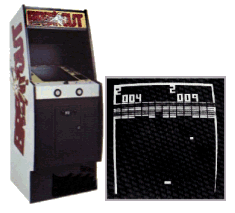
Breakout
En 1976 Atari contaba entre sus filas con un tal Steve Jobs y un tal Steve Wozniak que desarrollaron el juego Breakout, primer juego machaca… ver más
En 1976 Atari contaba entre sus filas con un tal Steve Jobs y un tal Steve Wozniak que desarrollaron el juego Breakout, primer juego machaca-bloques de la historia, que era una nueva variación de Pong. Ambos, usando componentes de Atari crearon el primer computador Apple. Ante el desinterés de Atari por su proyecto, Steve Jobs y Steve Wozniak crearon su propia empresa, Apple Computer Company, y entraron de lleno en la historia de las computadoras.
Canon Palmtronic 8
Canon Palmtronic 8M
Casio CQ-1
Casio FX-102
Casio MQ-1
Casio Pocket 8S
 Coleco Telstar
Coleco Telstar es una consola de videojuegos producida por Coleco. Solo tenía un juego; el Pong. Se empezó a vender a partir de junio de 19… ver más
Coleco Telstar es una consola de videojuegos producida por Coleco. Solo tenía un juego; el Pong. Se empezó a vender a partir de junio de 1976. Originalmente esta consola era un clon de la Atari Pong. Muchas variantes de esta consola fueron lanzadas a la venta en 1978. La línea de productos innovadores y el desvanecimiento inminente del Maquinas de Pong llevaron Coleco para hacer frente a borde de la bancarrota en 1980. Después, en 1982, Coleco lanzó la sucesora de esta consola: ColecoVision. (modelo 6040, 1976): Traía tres variantes del juego Pong ( hockey , balonmano , tenis ), dos paletas controladores fijos en la consola. Este fue el primer juego para utilizar el AY-3-8500 chip.
Coleco Telstar Classic
(modelo 6045, 1976): Igual que el Telstar, con caja de madera de lujo. ver más
(modelo 6045, 1976): Igual que el Telstar, con caja de madera de lujo.
 Compucolor 8001
Intelligent Systems Corporation (ISC) was started in 1973 by Charles A. Muench, to develop a color computer graphics terminal to compete wit… ver más
Intelligent Systems Corporation (ISC) was started in 1973 by Charles A. Muench, to develop a color computer graphics terminal to compete with the mechanical Teletype and monochrome glass TTY terminals commonly in use at this time. Their first product, advertised in February of 1976, if not earlier, was the Intecolor 8001 professional intelligent CRT terminal - a $1,395 kit to be assembled by the purchaser, featuring a huge 19-inch RCA delta-gun CRT. The system came with 4K of RAM memory as standard. It wasnt until December of 1976 when the Intecolor 8001 color terminal could be expanded from a computer interface device into a complete stand-alone computer: For an additional $1,295 ($2,690 total), the Intecolor 8001 could be converted into the Compucolor 8001 - an expanded, stand-alone micro-computer with built-in BASIC programming language.
 Cromemco Z-1
El Cromemco Z-1, lanzado en agosto de 1976, era un microcomputador basado en el bus S-100. Fue el primer microcomputador que usó el Zilog Z8… ver más
El Cromemco Z-1, lanzado en agosto de 1976, era un microcomputador basado en el bus S-100. Fue el primer microcomputador que usó el Zilog Z80 microprocesador y fue el primer microcomputador fabricado por Cromemco
Cromemco Z-2D
Drive Yourself Crazy
 Dumont Videoplay
clon Fairchild Channel F ver más
clon Fairchild Channel F
 EP TV Game EP 460
Emerson Videoplay
 Entex Gameroom Tele-Pong 3047
Gameroom Tele-Pong es un pong fabricado por Entex Industries en 1976.Es en blanco y negro y dispone de marcador manual en la propia maquina.… ver más
Gameroom Tele-Pong es un pong fabricado por Entex Industries en 1976.Es en blanco y negro y dispone de marcador manual en la propia maquina. Entex Tele-pong (3047) Binatone la comercializo como TV Game Unit (model n° 01 / 4990)
Entex Gameroom Tele-Pong 3047 white box
Epoch Electrotennis Silver
Electrotennis (o TV Tennis en japones) es la primera consola creada y vendida en Japon por una empresa japonesa, aunque anterior a esta se c… ver más
Electrotennis (o TV Tennis en japones) es la primera consola creada y vendida en Japon por una empresa japonesa, aunque anterior a esta se comercializaban diferentes tios de pong. Antes que la Cassette Vision o TV Vader, Epoch fabricó esta consola inalámbrica, que funciona con pilas y envía la señal a través de una antena separada que se conecta al televisor. A diferencia de los clasicos pongs, dispone de cierta inteligencia artificial, que permite jugar a un solo jugador, además de dobles. Por otra parte, el palito puede moverse a izquierda y derecha, no solo arriba y abajo. Utiliza un contador manual de puntos.
 Executive Games Face-Off
Face Off (AnalogDigital) 1976 PAL Prototype Face Off Rev. C (AnalogDigital) 1976 Face Off Rev. C-1 (AnalogDigital) 1976 Face Off Rev. E1 (An… ver más
Face Off (AnalogDigital) 1976 PAL Prototype Face Off Rev. C (AnalogDigital) 1976 Face Off Rev. C-1 (AnalogDigital) 1976 Face Off Rev. E1 (AnalogDigital) 1976
 FKF TV Games Model 100 TV Spiel
Fairchild Channel F
El nombre inicial con el que se anunciaba era Fairchild Video Entertainment System (VES), pero cuando Atari empezó a vender su VCS, decidier… ver más
El nombre inicial con el que se anunciaba era Fairchild Video Entertainment System (VES), pero cuando Atari empezó a vender su VCS, decidieron promocionarla simplemente como Channel F.
Fairchild Video Entertainment System Box
 First Dimension - Video Sports model 76
First Dimension - Video Sports model 76c
First Dimension - Video Sports model Mark II
 GA-Daishin Telespo
 Gakken EX-120 System
Gakken EX-15 System
Gakken EX-150 System
Gakken EX-181 System
Gakken EX-30 System
Gakken EX-60 System
Gakken EX-FM System
General Instruments AY-3-8500
The AY-3-8500 Ball Paddle integrated circuit was the first in a series of ICs from General Instrument designed for the consumer video game m… ver más
The AY-3-8500 Ball Paddle integrated circuit was the first in a series of ICs from General Instrument designed for the consumer video game market. These chips were designed to output video to an RF modulator, which would then display the game on a domestic television set. The AY-3-8500 contained six selectable games — tennis (a.k.a. Pong), soccer, squash, practice, and two rifle shooting games. The AY-3-8500 was the 625-line PAL version and the AY-3-8500-1 was the 525-line NTSC version. It was introduced in 1976, Coleco becoming the first customer having been introduced to the IC development by Ralph H. Baer.[1] A minimum number of external components were needed to build a complete system. The AY-3-8500 was the first version. It played seven Pong variations. The video was in black-and-white, although it was possible to colorize the game by using an additional chip, such as the AY-3-8515.
General Instruments AY-3-8500 Color AY-3-8515
General Instrument AY-3-8615 (1976) Colour picture encoder for the AY-3-8600 ver más
General Instrument AY-3-8615 (1976) Colour picture encoder for the AY-3-8600
General Instruments AY-3-8765
General Instruments AY-3-8800
General Instruments AY-3-8888
General Instruments AY-3-8889
 Glorytone Video Olympiad
Glorytone Video Olympiad Wood
Granada TV Game EP500
E P Electronic (HK) LTD. ubicada en Hong Kong, se encargó de la fabricación de la consola, desarrollando dos modelos: la TV Game EP500, y la… ver más
E P Electronic (HK) LTD. ubicada en Hong Kong, se encargó de la fabricación de la consola, desarrollando dos modelos: la TV Game EP500, y la TV Game EP800; para posteriormente ser comercializada bajo diferentes marcas. Se caracteriza por utilizar el famoso chipset AY-3-8500, muy utilizado por las consolas de la época; y al igual que sus compañeras posee 4 variaciones de Pong: tenis, hockey, squash y frontón (llamado “practice” en la consola). adema´s de los dos mandos integrados en la consola, incluye otros dos que se conectan a la misma. Estas consolas tenían licencia de Magnavox.
 Granada Video Olympiad
Granada Video Sports
Grandstand Video Entertainment Computer
Grandstand Video Entertainment Computer Other
 Handi Pong IV kit
This is a very rare dedicated pong console which doesnt use any dedicated chip (like AY-3-8500-1), it only has discrete components (TTLs). W… ver más
This is a very rare dedicated pong console which doesnt use any dedicated chip (like AY-3-8500-1), it only has discrete components (TTLs). Was released in 1976 by Video Marketing Corp. and only plays two games: Tennis and Handball. It features scoring on screen thanks to a MM5841 chip (those chips were usually used for displaying time on a TV but can also be used as a scoring display) and you can also play versus a robot (left or right player) or you can also select the two robots to plays against themselves. There is a detailed review of this pong console which is published in the magazine Elementary Electronics - January-February 1977 edition.
 Heathkit ET-3400
Heathkit GD-1380
Heathkit was a famous kit manufacturer in the 1970s. Their catalog was long: it proposed everything from simple projects to advanced test eq… ver más
Heathkit was a famous kit manufacturer in the 1970s. Their catalog was long: it proposed everything from simple projects to advanced test equipment, color TV sets, Hi-Fi, and of course video games. This kit (model GD-1380) was released in 1976. It plays the six games of the AY-3-8500 chip, and has several interesting features. First, it requires a Heathkit TV set to operate because of its composite output. Back in 1976, only monitors and hi-tech equipment had a composite input. To use this system, the user had to open his TV set in order to connect a few wires to its electronic circuits. This is the case with the Heathkit TV sets: the user manual explains how to connect the system to several TV sets released by Heathkit. The system has another interesting feature: the sound does not come from the system itself like most of the other PONG consoles, but comes from the TV set. The main reason for this is the direct connexion of the system to the TV set. Since the TV had to be open for connecting, why not connecting additional wires to the audio amplifier of the TV instead of using a speaker in the system ? Using the TV as audio output was not possible with regular systems which used a video modulator. Outputing the sound to the TV would have required additional circuits, hence a higher price of the systems. Here, the system benefits of a direct connexion to the TV set, hence the possibility of using the audio circuits of the TV without additional costs. A last thing: the blue electronic gun of the system is very funny, and the user manual is extremely detailed.
Heathkit GD-1999
Clon del National Semiconductor Adversary system (model 370), fabricado tras el lanzamiento del chip MM-57100 en 1976. Solo se diferencian e… ver más
Clon del National Semiconductor Adversary system (model 370), fabricado tras el lanzamiento del chip MM-57100 en 1976. Solo se diferencian en las etiquetas de los mandos y la unidad central. Se puede considerar un semi-kit,ya que aunque había que montar las piezas, todos los componentes de la placa venían soldados y ajustados.
Hewlett-Packard 21
 Homeland 8011
Homeland 8108
ITT Telematch Processor
 Ingelen Telematch Processor
Intel 8048
he MCS-48 microcontroller (µC) series, Intels first microcontroller, was originally released in 1976. Its first members were 8048, 8035 and … ver más
he MCS-48 microcontroller (µC) series, Intels first microcontroller, was originally released in 1976. Its first members were 8048, 8035 and 8748. Initially, this family was produced using NMOS (n-type metal–oxide–semiconductor) technology. In the early 1980s, it became available in CMOS technology. It was still manufactured into the 1990s to support older designs that still used it. The MCS-48 series has a modified Harvard architecture, with internal or external program ROM and 64–256 bytes of internal (on-chip) RAM. The I/O is mapped into its own address space, separate from programs and data. The 8048 is probably the most prominent member of Intels MCS-48 family of microcontrollers. Device Internal Memory Remarks 8020 1K × 8 ROM 64 × 8 RAM subset of 8048, 20 pins, only 13 I/O lines 8021 1K × 8 ROM 64 × 8 RAM subset of 8048, 28 pins, 21 I/O lines 8022 2K × 8 ROM 64 × 8 RAM subset of 8048, A/D-converter 8035 none 64 × 8 RAM 8039 none 128 × 8 RAM 8040 none 256 × 8 RAM 8048 1K × 8 ROM 64 × 8 RAM 8049 2K × 8 ROM 128 × 8 RAM 8050 4K x 8 ROM 256 × 8 RAM 8748 1K × 8 EPROM 64 × 8 RAM 8749 2K × 8 EPROM 128 × 8 RAM 87P50 ext. ROM socket 256 × 8 RAM Has piggy-back socket for 2758/2716/2732 EPROM. 8648 1K × 8 OTP EPROM 64 × 8 RAM factory OTP EPROM
Intel 8085
The Intel 8085 is an 8-bit processor made by Intel and introduced in 1976. It is binary compatible with the Intel 8080 but requires less sup… ver más
The Intel 8085 is an 8-bit processor made by Intel and introduced in 1976. It is binary compatible with the Intel 8080 but requires less supporting hardware, thus allowing simpler and less expensive microcomputer systems to be built. Intel made the 8085 as a significant improvement on the 8080, both in performance and handling issues. It has improved hardware by only using 5V power (the 8080 required 5V, -5V and 12V), and clock generator and bus controller circuits on-chip. The 5 in the model number came from the fact that the 8085 required only a 5-volt power supply. The 8085 was a transition design on the way to the 16-bit 8086. There are multiple versions of Intel 8085 processor: The original 8085, the 8085A with bug fixes and the 8085AH HMOS version. Some second-source manufactures also produced CMOS version of the 8085 microprocessor (80C85).
Intercolor 8001
 Kanal 34
 Lasonic 2000 TV Game
Lasonic Jeutele Sitar
 Little Professor Texas Instrument
The Little Professor is a Texas Instrument backwards-functioning calculator designed for children ages 5 to 9. Instead of providing the answ… ver más
The Little Professor is a Texas Instrument backwards-functioning calculator designed for children ages 5 to 9. Instead of providing the answer to a mathematical expression entered by the user, it generates unsolved expressions and prompts the user for the answer.
 Lloyds TV Sports 801
clones Sonico 406-6 Color TV Sports Accona 40G-G Color TV Sports Video Game Tessar Color TV Sport 406-6 Conic TV Color Sport TVG-406-6 Ajax … ver más
clones Sonico 406-6 Color TV Sports Accona 40G-G Color TV Sports Video Game Tessar Color TV Sport 406-6 Conic TV Color Sport TVG-406-6 Ajax TVG-406-6 C.I.C. TVG-406-6 Color Video Spiel
Lloyds TV Sports 812
 Luxor Sportsman 2001
Luxor Video Entertaiment Computer
Luxor Video Entertaiment System
clon Fairchild Channel F ver más
clon Fairchild Channel F
Magnavox Odisea
La caja original tiene una pegatina con el nombre Odisea. Los accesorios también fueron traducidos al castellano. ver más
La caja original tiene una pegatina con el nombre Odisea. Los accesorios también fueron traducidos al castellano.
 Magnavox Odyssey 300
La Odyssey 300, de 1976, pretendía competir en el mercado directamente con la Coleco Telstar El ángulo de rebote de la bola depende de la po… ver más
La Odyssey 300, de 1976, pretendía competir en el mercado directamente con la Coleco Telstar El ángulo de rebote de la bola depende de la posición en la que toque la pala, eliminando además el control de dirección de modelos anteriores. Ofrece los mismos 3 juegos que la Odyssey 200, pero añade tres niveles de dificultad: Novato, Intermedio y Experto. Este fue el primer sistema de Magnavox en mostrar un marcador en pantalla.
Magnavox Odyssey 400
La Odyssey 400, de 1976, es similar al modelo 200 (mismos juegos y botones de control), pero le añadieron saque automático de la bola y un c… ver más
La Odyssey 400, de 1976, es similar al modelo 200 (mismos juegos y botones de control), pero le añadieron saque automático de la bola y un contador digital en pantalla (mediante un chip adicional de Texas Instruments).
 Magnavox Odyssey 4305
Magnavox Odyssey 500
La Odyssey 500, de 1976, es como la Odyssey 400, a la que le sustituyeron la linea vertical que representa a cada jugador por un gráfico con… ver más
La Odyssey 500, de 1976, es como la Odyssey 400, a la que le sustituyeron la linea vertical que representa a cada jugador por un gráfico con apariencia remotamente parecida a un humano. Tenía tres variaciones de juegos y un cuarto (Soccer), obtenido al utilizar el jugador de squash y el campo de hockey.
 Marubeni Sport King Model-101
スポーツキング101( カラー箱・YSA表記有り) ver más
スポーツキング101( カラー箱・YSA表記有り)
Marubeni Sport King Model-101 caja bn
スポーツキング101(単色箱・黒本体) ver más
スポーツキング101(単色箱・黒本体)
Marubeni Sport King Model-103
スポーツキング103( カラー箱・YSA表記有り) ver más
スポーツキング103( カラー箱・YSA表記有り)
 Mec TV Games TVG 1000
 Mecca EP-460
Mecca EP-500
EPElectronics Mecca TV Game EP500 ver más
EPElectronics Mecca TV Game EP500
Mecca EP460
Mecca TV Game EP500
 Mego Star Trek Phaser Battle
Mestron Fernseh Spiel TVG 2006
Monteverdi TV Sports 825
 National Semiconductor 200
National Semiconductor Adversary
The story is far from finished. If GI released the AY-3-8500 in 1976, the competition was already present. National Semiconductor (NS) rele… ver más
The story is far from finished. If GI released the AY-3-8500 in 1976, the competition was already present. National Semiconductor (NS) released their chip integrating three Ball Paddle games: the MM-57100N (also released as the MM-57105N in PAL format). NS advertised the chip as playing games with true and realistic colors (the background was green for Tennis, blue for Hockey, and magenta for Squash). This major feature probably boosted the sales. As a matter of fact, the basic configuration of the GI AY-3-8500, 8550 and 8600 chips delivered a black and white picture, and another GI chip was required to produce color pictures, hence a higher cost. The MM-57100N chip and its PAL equivalent only required two interfacing chips: the MM-53104N clock driver and the LM1889N color modulator. As the LM1889N was cheaper than GIs color encoders and widely available, every system designed with the NS chips played game in colors, as opposed to many systems built with GI chips. The NS games also differed from the GI games. For instance, each player appeared alternatively in the Squash game when the ball was hit, and the Hockey game showed six square opponents (organised in two groups of three) moving up and down on the screen. The sound was directly sent to the TV set instead of coming from a speaker in the system. The game selection only required a push-button instead of a switch (rotary or linear) which could fail after many game selections. The scores appeared once a player lost the ball, the bats could have three different sizes, and the ball accelerated once it bounced four times on the players. Finally, the games could also be played in solo: the single player controlled both sides of the games using the same controller. For the release of this new chip, NS launched a small system called National Adversary (model 370). Although not very nice, it played the three games of the chip and sold pretty well. The same system was sold in semi-kit form by Heathkit as Model GD-1999 (the circuit board was already assembled). The only problem was the competitive price of the AY-3-8500 and also its wide reputation as most manufacturers used it. Although NS had a pretty smart idea by releasing the MM-57100N chip, the increasing success of GI became too high for NS, and facing the situation became more and more difficult. As an attempt to survive this situation, NS released another chip in 1978: the MM-57106N (also known as MM-57186N in PAL format). This one played six different games: those of the MM-57100N, plus Wipe-Out (Breakout clone), Flipper and Football. Each game was playable in several variants, giving a total of twenty-three games. This chip was not successful and the only systems known to use it are the Philips N30 (and its equivalents sold under the Radiola and Schneider brands) and the Philips Odyssey 2100, both released in Europe. NS advertised an improved Adversary system (model 600) based on this chip, but no specimen surfaced yet.
 Nintendo Kosenju Duck Hunt
Nobility TV Game EP500
Oki MSL9320
 Orelec PP-2000
El PP-2000 utiliza dos potenciometros para ajustar el video vertical y horizontal y otros dos para el movimiento de cada uno de los jugadore… ver más
El PP-2000 utiliza dos potenciometros para ajustar el video vertical y horizontal y otros dos para el movimiento de cada uno de los jugadores. Dispone de dos juegos: Tennis (Ping-Pong) y Pelota. La placa contiene 11 circuitos integrados TTL, puertas de lógica simple: tres MM-7400 (similares al 7400), y ocho MM-7402 (como el 7402).
Philips Odyssey 200
La Philips Odyssey 200 es igual a la Magnavox Odyssey 200, excepto por la pegatina del nombre. ver más
La Philips Odyssey 200 es igual a la Magnavox Odyssey 200, excepto por la pegatina del nombre.
Piccolo Professore - Little Professor
 Playtech Telesport
 PolyMorphic Systems Poly-88
With the release of their CPU card, PolyMorphic began selling complete systems. Their first was the Poly-88, housed in a 5-slot S100 chassis… ver más
With the release of their CPU card, PolyMorphic began selling complete systems. Their first was the Poly-88, housed in a 5-slot S100 chassis, with additional side-mounted S-100 connectors for the purpose of joining chassis together. This unit earned the nickname orange toaster due to its orange metal cover, and the fact that the S-100 cards generated noticeable heat. The Poly-88 was available in kit form, or assembled. It was originally called the Micro-Altair, but after objections from MITS, manufacturers of the Altair, the name was changed.
 Pong DN76
TV-Ping-Pong (model DN76) es un pong fabricado en Alemania en 1976 por una compañia llamada EA. Solo tiene un juego, Tenis para dos jugador… ver más
TV-Ping-Pong (model DN76) es un pong fabricado en Alemania en 1976 por una compañia llamada EA. Solo tiene un juego, Tenis para dos jugadores. Es tan simple que ni siquiera aparece en pantalla la puntuación, solo las palas, la pelota y una linea central. El nivel de dificultad se basa solo en modificar la velocidad de la bola. No utiliza los conocidos PongOnAChip, pero sí componentes analógicos y digitales
 Prinztronic Tournament VM8
Similar al Videomaster Superscore VM-8 ver más
Similar al Videomaster Superscore VM-8
 Qualitron QI 1015
 Quorum 31M
 Radio Shack TV Scoreboard - Model 60-3051
La cadena de tiendas americana Radio Shack decidió comercializar bajo su sello varios tipos de pong. Posteriormente haría lo mismo con algun… ver más
La cadena de tiendas americana Radio Shack decidió comercializar bajo su sello varios tipos de pong. Posteriormente haría lo mismo con algunos ordenadores (TRS 80) y consolas (Tandyvision One) del fabricante Tandy. Como era costumbre en esa época, las cajas de los equipos incluían imágenes de varios miembros de la familia jugando frente al televisor.
Radio Shack TV Scoreboard - Model 60-3052
 Radofin 1292 Advanced Programmable Video Syst
En 1976, la empresa alemana Radofin creo la primera 1292 Advanced Programmable Video System, siendo licenciada posteriormente a otras empres… ver más
En 1976, la empresa alemana Radofin creo la primera 1292 Advanced Programmable Video System, siendo licenciada posteriormente a otras empresas como Acetronic, Prinztronic, Fountain, Grandstand, Audiosonic, Hanimex y Lansay. Algunas de las consolas solo diferían del original en el logo, pero otras eran rediseñadas completamente. En Alemania también se creó la Interton VC 4000, con un diseño y especificaciones similares a la 1292 AVPS. Según Interton, su diseño es anterior, de 1974, aunque no la comercializaron hasta 1978.
 Richin TVG-2006
 Ricochet Color TV Game
Ricochet Formula 500
Ricochet MT1A
 Roberts Paddle IV
Roberts Paddle VI
 Rockwell AIM-65
Rockwell AIM-65Training
 Saba Videoplay
Saba Videoplay 2
 Sears Tele-Games Super Pong
Sears Tele-Games Super Pong IV
 Sharp Elsi Mate EL-204
Sol-20 Terminal Computer
Laying claim to be the first fully-assembled microcomputer with a built-in keyboard and television output, the Sol-20 was launched back in 1… ver más
Laying claim to be the first fully-assembled microcomputer with a built-in keyboard and television output, the Sol-20 was launched back in 1976. It had more in common with the Altair 8800s and IMSAI 8080s of the day, than it did with the Apple and Commodore computers that were soon to follow, despite looking more like the latter
 Sportel Video TV Game
 Superlectron TV Challenger Series 2000
Swervin Derby
 Tele Pong
Tele Pong IV
 Tele-Match Concert Hall IV 6600
Tele-Match Concert Hall IV 8800
Telenova Tele Pong
Telestart
Coleco comercializa Telestart ver más
Coleco comercializa Telestart
 Teletenis Multijuegos
Como no podía ser de otro modo, en España se desarrolló un clon de la Interton Video 2000, el Togisa Teletenis Multijuegos, que también most… ver más
Como no podía ser de otro modo, en España se desarrolló un clon de la Interton Video 2000, el Togisa Teletenis Multijuegos, que también mostraba en las instrucciones dos juegos (carrera de coches y bombardero naval) que no llegaron a desarrollarse-copiarse. Lo que si se hizo fue quitarle el cable de conexión al televisor y colocarle a la máquina una antena que emitía directamente la señal hasta la tele ... con dos cojones.
Texas Instrument SR-56
Texas Instrument TI-30
Texas Instruments TMS1955
4 Ball Paddle variants ver más
4 Ball Paddle variants
Texas Instruments TMS1965
Equivalent to AY-3-8500 ver más
Equivalent to AY-3-8500
 Teyboll Automatico
 Toshiba BC-819
Toshiba LC1028
 Unico L0831
 Unisonic Sportsman T101
Unisonic Tournament 100
Unisonic Tournament 102
Unisonic Tournament 150
Unisonic Tournament 200
 Unitrex 801-MR
Universal Research Laboratories F4301
 Universum Color Multi-Spiel
Universum Multi-Spiel
Video Action IV Indy 500
El último modelo de Video Actión apareció a finales de 1976. Si bien ya estaba disponible el conocido AY-3-8500, URL decidió añadir dos jueg… ver más
El último modelo de Video Actión apareció a finales de 1976. Si bien ya estaba disponible el conocido AY-3-8500, URL decidió añadir dos juegos de coches a los dos de la VA-II utilizando chips en lugar de componentes discretos. Dada la complejidad de estos juegos, tuvo que emplear dos chips conectados en lugar un pong-on-a-chip.
Video Action VA-III
Con un diseño menos sobrio que la VA-II, que consistía en una simple tabla de formica y una caja con el panel de control, en 1976 salió al m… ver más
Con un diseño menos sobrio que la VA-II, que consistía en una simple tabla de formica y una caja con el panel de control, en 1976 salió al mercado la VA-III Más económica que el modelo VA-II, disponía de 2 juegos en lugar de tres (eliminaron el Soccer). Lo interesante es el modo Robot, que permitía jugar contra la máquina, capacidad disponible en muy pocos modelos de pong.
 Video Sports VS-1
Windsor TV Game EP500
 WonderWizard 7702
Zilog Z80
ZiLOG is a manufacturer of 8-bit CPUs, and is most famous for its Z80 series. Zilog was incorporated in California in 1974 by Federico Faggi… ver más
ZiLOG is a manufacturer of 8-bit CPUs, and is most famous for its Z80 series. Zilog was incorporated in California in 1974 by Federico Faggin, who left Intel after working on the 8080, and the Z80 shared many features with it. After the Z80 Zilog introduced 16-bit and 32-bit processors, but these were not particularly successful, and the company refocused on the microcontroller market, producing both basic CPUs and application-specific integrated circuits/standard products (ASICs/ASSPs) built around a CPU core. As well as producing processors, Zilog have produced several other components. One of the most famous was the Z8530 serial communications controller as found on Sun SPARCstations and SPARCservers up to the SPARCstation 20. The company became a subsidiary of Exxon in 1980, but the management and employees bought it back in 1989. It went public in 1991, but was acquired in 1998 by Texas Pacific Group, who, after chip prices plummeted, reorganized the company in a Chapter 11 bankruptcy in late 2001.
Apple como sociedad
En enero de este año se constituye Apple como sociedad. Presentan el Apple II, el cual incorporaba teclado y fuente de alimentación ver más
En enero de este año se constituye Apple como sociedad. Presentan el Apple II, el cual incorporaba teclado y fuente de alimentación
Death Race
Aparece el juego de arcade Death race, de Exidy, inspirado en la película Death race 2000. Objetivo: matar peatones. Despertó las primeras p… ver más
Aparece el juego de arcade Death race, de Exidy, inspirado en la película Death race 2000. Objetivo: matar peatones. Despertó las primeras polémicas sobre violencia y videojuegos. Fue retirado
2 Player Football
Clon del Radio Shacks Two-Player Football ver más
Clon del Radio Shacks Two-Player Football
2600 compatible 96 builtin
 A10 9010
A10 9010 black
A10 9012
A10 9012 White
APF Match
APF TV 442
APF TV FUN 401T
 Academy Apollo 80
Academy D-5996 Programmable TV Game Console
Academy Most Exciting Home Video Game D-5614
Academy TVG-406-6
Academy Video Game D-5654
Academy Video Game D-5715
 Acetronic Colour Tv Game
Acetronic 10 Realistic Sports Action TV Games ver más
Acetronic 10 Realistic Sports Action TV Games
Acetronic Sports Action TV Game 922
 Aciko Colour Tv Game
Activision Family Game
Industria Argentina ver más
Industria Argentina
Adman Grandstand Model 4600
Adman Grandstand Model 5000
Adman Sportsvision TV Game Model 1000
 Ags TVG 101-4
 Ajax Color Video Game BM-1000
Ajax TV Game 406-6
Ajax TV Game AU-807
Ajax TV Game T-800
Ajax TV Game T-800C
Ajax TV Sports Game T-338
Ajax Video Games TG-621
 Akur TVG-SD-01-8 Color
 Alcatel Visiomat 11
 Alex Video Spiel TG-621
 Alfa Electronics Videotronic
Alfa Electronics Videotronic II 3388
carcasa negra ver más
carcasa negra
Alfa Electronics Videotronic II 8550C
Model 8550C Carcasa roja ver más
Model 8550C Carcasa roja
 Alltronic Colour TV Game Centre
Alltronic Electronic TV Game Centre Model 15
Alltronic HK 1350
 Ameltone Most Exciting Home Video Game D-5614
Ameltone Stadium 4002
Ameltone Stadium BW-11
Página 2 de 22