Timeline
La historia completa: lanzamientos, quiebras, inventos y momentos clave de la industria, década a década.
Mostrando eventos 1–250 de 5387.
 Donner Scientific Company Model 30
 Kasco Gun Smoke
Kasco Indy 500
Kasco Mini Drive
Sega Jet Rocket
Namco Periscope
Sega Periscope
 Ten Billion
Ultra Hand
 The Brown Box
This machine paved the way for the video games of today. In 1967, Ralph Baer and his colleagues at Sanders Associates, Inc. developed a prot… ver más
This machine paved the way for the video games of today. In 1967, Ralph Baer and his colleagues at Sanders Associates, Inc. developed a prototype for the first multiplayer, multiprogram video game system. Since Sanders hoped to license the technology for a commercial venture, Baer understood that the games had to be fun or investors and consumers would not be interested. In an oral history interview (copies available in the Archives Center at the National Museum of American History), Ralph Baer recalled, “The minute we played ping-pong, we knew we had a product. Before that we weren’t too sure.”Originally called TV Game Unit #7, much like the Pump Unit before it, it became far better known by its nickname, “The Brown Box.” The name comes from the brown wood-grain, self-adhesive vinyl used to make the prototype look more attractive to potential investors. The Brown Box, though only a prototype, had basic features that most video games consoles still have today: two controls and a multigame program system. The Brown Box could be programmed to play a variety of games by flipping the switches along the front of the unit, as can be seen in the picture. Program cards were used to show which switches needed to be set for specific games. Brown Box games included ping-pong, checkers, four different sports games, target shooting with the use of a lightgun and a golf putting game, which required the use of a special attachment. Sanders licensed the Brown Box to Magnavox, which released the system as the Magnavox Odyssey in 1972.
 Hewlett Packard HP-9100
The Hewlett-Packard 9100A (hp 9100A) is an early programmable calculator (or computer), first appearing in 1968. HP called it a desktop calc… ver más
The Hewlett-Packard 9100A (hp 9100A) is an early programmable calculator (or computer), first appearing in 1968. HP called it a desktop calculator because, as Bill Hewlett said, If we had called it a computer, it would have been rejected by our customers computer gurus because it didnt look like an IBM. We therefore decided to call it a calculator, and all such nonsense disappeared.
 Stanford Research Institute Mouse Prototype
Telefunken Rollkugel
 Tim And Chris Stamper
Chicago Coin Speedway
Sega Grand Prix
Canon Canola163
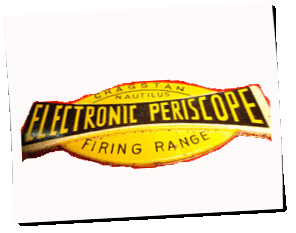 Cragstan Periscope-Firing Range
Este es el primer juego electromecánico alimentado con pilas, predecesor del AutoRace, que sí es totalmente electrónico. Fabricado en 1951 c… ver más
Este es el primer juego electromecánico alimentado con pilas, predecesor del AutoRace, que sí es totalmente electrónico. Fabricado en 1951 con la carcasa totalmente mecánica (latas de café recicladas), incluye un trípode que lo acerca más a una tabletop que a un handheld. Al pulsar en Start, una cinta transparente con barcos impresos empieza a moverse, mientras una luz trasera los ilumina. Al pulsar Fire, una luz roja parpadea y se oye un sonido. No hay marcador ni forma de identificar que se ha acertado con el disparo.
Cragstan Periscope-Firing Range model 2
En el primer modelo solo era posible ver la pantalla para un solo jugador y cabe sospechar que hacían trampa, el segundo modelo lanzado poco… ver más
En el primer modelo solo era posible ver la pantalla para un solo jugador y cabe sospechar que hacían trampa, el segundo modelo lanzado poco tiempo después incluía una pantalla claramente visible frontal y dos pantallas adicionales a los lados “para los amigos” *Un videojuego o juego de video es un juego electrónico en el que una o más personas interactúan, por medio de un controlador, con un dispositivo dotado de imágenes de vídeo. *Handheld electronic game(s) are very small, portable devices for playing interactive electronic games, often miniaturized versions of video games. The controls, display and speakers are all part of a single unit. Rather than a general-purpose screen made up of a grid of small pixels, they usually have custom displays designed to play one game. This simplicity means they can be made as small as a digital watch, and sometimes are. The visual output of these games can range from a few small light bulbs or LED lights to calculator-like alphanumerical screens; later these were mostly displaced by liquid crystal and vacuum fluorescent display screens with detailed images and in the case of VFD games, color *A handheld video game is a video game designed for a handheld device. In the past, this primarily meant handheld game consoles such as Nintendos Game Boy line. Una videoconsola portátil es un dispositivo electrónico ligero que permite jugar videojuegos y en el que, a diferencia de una videoconsola de sobremesa, los controles, la pantalla, los altavoces y la alimentación (baterías) están integrados en la misma unidad y todo ello con un pequeño tamaño, para poder llevarla y jugar en cualquier lugar o momento En 1976 Mattel presentó el primer juego electrónico portátil con el lanzamiento de Auto Race
 DEC PDP-1
 DEC-PDP
Electro Bird
Electro Poker
Electro Safari
 Hispano-Olivetti Electrosuma
Hispano-Olivetti Restysuma 20
Jumping Bottle
Kosenju SP Gun
Kosenju SP Rifle
Kosenju SP Series
Electronic toy guns that could shoot targets. The following products were a part of the series: Gun - A handheld gun, this was the cheaper … ver más
Electronic toy guns that could shoot targets. The following products were a part of the series: Gun - A handheld gun, this was the cheaper alternative to the product. Rifle - A lot more expensive and larger. The following targets were available: Electro Safari, Electro Bird, Jumping Bottle, Lion, Roulette, and Electro Poker.
 Light Gun
Una pistola de luz (light gun) es un dispositivo apuntador para ordenadores y un dispositivo de control para videojuegos y máquinas recreati… ver más
Una pistola de luz (light gun) es un dispositivo apuntador para ordenadores y un dispositivo de control para videojuegos y máquinas recreativas. Las primeras pistolas de luz aparecieron en los años treinta (1930), como consecuencia del desarrollo de la sensibilidad a la luz en las válvulas de vacío. Poco después, esta tecnología se aplicó a los juegos de disparo, con ejemplos como Seeburg Ray-O-Lite en 1936. Estos primeros juegos de disparo empleaban pequeños objetivos (generalmente en movimiento) dispuestos en una válvula sensible a la luz; el jugador usaba una pistola (un rifle en la mayoría de los casos) que emitía un rayo de luz cuando el pulsador era accionado. Si el rayo golpeaba el objetivo, se producía un acierto. Las pistolas de luz modernas basadas en pantallas trabajan con el principio opuesto: el sensor se construye en la propia pistola y los objetivos de la pantalla emiten luz (en vez de la pistola). La primera pistola de luz de este tipo se empleó en el ordenador MIT Whirlwind. La pistola de luz y su descendiente, el lápiz óptico, actualmente rara vez son empleados como punteros en los ordenadores. Las razones son dos: la primera es la popularidad de los ratones; y la segunda, se refiere a los cambios en la tecnología de los monitores (las pistolas de luz sólo funcionan con monitores CRT).
Lion
 Nixdorf System 820
Rabbit Coaster
Roulette
Sega Gun Fight
Ultra Coaster
Computer Space
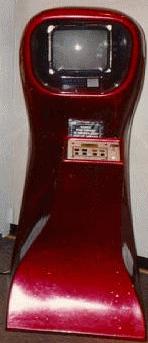
En 1971 Nolan Bushnell desarrolló para Nutting Associates el juego Computer Space para máquina recreativa. El juego era una adaptación de Sp… ver más
En 1971 Nolan Bushnell desarrolló para Nutting Associates el juego Computer Space para máquina recreativa. El juego era una adaptación de Spacewar. Nolan conoció Spacewar en la universidad de Utah y pensó que trasladar esa experiencia al gran público sería todo un negocio. Fué el primer videojuego genuino en este tipo de máquinas y le dió a Nolan Bushnell suficiente dinero para fundar Atari. La máquina tenía un diseño futurista que aún hoy resulta encantador. Sin embargo, el juego no resultaba tan adictivo y simple como el original Spacewar.
Custom Gunman
Custom Lever Action Rifle
Custom Lion
Custom Target
 Intel 4004
The 4004 was the first single chip microprocessor, originally designed and manufactured by Intel for Busicom for use in their calculators. I… ver más
The 4004 was the first single chip microprocessor, originally designed and manufactured by Intel for Busicom for use in their calculators. It was invented by Intel engineers Federico Faggin, Ted Hoff, and Stan Mazor and introduced in November 1971.
 Kenbak-1
El computador Kenbak-1 está considerado como el primer “ordenador personal” disponible comercialmente. Esta designación le fue otorgada por … ver más
El computador Kenbak-1 está considerado como el primer “ordenador personal” disponible comercialmente. Esta designación le fue otorgada por el Computer History Museum en el año 1970 a partir de un concurso realizado con el objetivo de registrar la historia de la computación. Este equipo fue diseñado y fabricado por John Blankenbaker (quien creó la Kenbak Corporation) y comenzó a comercializarse en el año 1971. El objetivo principal de este equipo era el mercado educacional, sin embargo, su comercialización no fue un éxito, ya que únicamente se vendieron 40 equipos, a un coste de 750 dólares cada uno, de los que solo hay referencias de que se conserven 10 ejemplares en la actualidad en varias colecciones. En 1973 cesó la producción y Kenbak Corporation cerró
Kosenju Custom Series
The successor to the Kôsenjû SP series, these guns could shoot much farther (whereas the original could only shoot around 24 feet, this one … ver más
The successor to the Kôsenjû SP series, these guns could shoot much farther (whereas the original could only shoot around 24 feet, this one could shoot to up to 300 feet). The guns included a Lever Action Rifle and a Gun, the latter being the cheapest alternative. The targets included Cutstom Gunman, Custom Lion and Custom Target.
Atari
En 1972 Nolan Bushnell funda en Estados Unidos, junto con Ted Dabney, la empresa Syzygy, que rápidamente es renombrada como Atari. Ese mismo… ver más
En 1972 Nolan Bushnell funda en Estados Unidos, junto con Ted Dabney, la empresa Syzygy, que rápidamente es renombrada como Atari. Ese mismo año presentan una máquina recreativa de monedas con el juego Pong, versión de Tennis For Two. Obtuvo un gran éxito y en 1975 Atari ofrece la Atari Pong, videoconsola doméstica que se conectaba a un aparato de tv y permitía jugar al juego Pong en el hogar. En 1976 Bushnell vende Atari a Warner Communications por unos 30 millones de dólares de la época. Pero lo mejor estaba por llegar, el lanzamiento de la consola Atari 2600 supuso un hito, que hizo a la empresa líder en el mercado de videoconsolas durante casi toda la década siguiente. En los años 80 la palabra Atari llegó a ser usada como sinónimo de consola de videojuegos, incluso para referirse a productos de otras marcas
 Bowmar Ten 901D
The Klixon keyboard was a brand and design of keyboard, which became synonymous with making a clicking sound. The keys made a unique clickin… ver más
The Klixon keyboard was a brand and design of keyboard, which became synonymous with making a clicking sound. The keys made a unique clicking sound, and the touch and feel to them enabled users to input numbers quickly. Klixon keys became very popular and many calculator manufacturers incorporated them. The switch mechanism was a progressive development due to the popularity of the large adding machines earlier used in industry. In digital electronics, the quality of the key contacts is a critical feature due to an issue known as key bounce. Hence, it is vital that the metal contacts are reliable and to the highest quality. Consequently, these keys utilised gold contacts, which provided a proper electrical contact when required.
Casio Mini CM-605
Casio Mini CM-607
Hewlett Packard HP-9830A
The HP 9800 is a family of what were initially called programmable calculators and later desktop computers that were made by Hewlett-Packard… ver más
The HP 9800 is a family of what were initially called programmable calculators and later desktop computers that were made by Hewlett-Packard, replacing their first HP 9100 calculator. It is also named 98 line. The 9830 and its successors were true computers in the modern sense of the term, complete with a powerful BASIC language interpreter. Introduced in 1972, was the top of the 9800 line, with the addition of a BASIC interpreter in read-only memory (ROM). HP itself referred to it as a calculator.
Intel 8008
The Intel 8008 was an early CPU designed and manufactured by Intel, introduced in April, 1972. ver más
The Intel 8008 was an early CPU designed and manufactured by Intel, introduced in April, 1972.
Magnavox Odyssey
Comercializada por la filial de Philips en Estados Unidos, la Magnavox Odyssey es la primera videoconsola de la historia. Fue desarrollada p… ver más
Comercializada por la filial de Philips en Estados Unidos, la Magnavox Odyssey es la primera videoconsola de la historia. Fue desarrollada por Ralph Baer (apodado «el padre de los videojuegos caseros») y lanzada en las tiendas norteamericanas a finales del año 1972, convirtiéndose en un éxito de ventas en muy poco tiempo. El prototipo de esta consola, desarrollado en 1968, es conocido como Brown Box (Caja Marrón) entre los coleccionistas de videojuegos. La Magnavox Odyssey fue el primer sistema casero de videojuegos. El 27 de enero de 1972, Magnavox comenzó la producción de la máquina, y el sistema fue lanzado en mayo. Se vendieron ese año 100,000 unidades a unos $200 por unidad. El lanzamiento de la Odyssey generó un caso severo de la locura de Pong, y compañías por todo el mundo comenzaron a desarrollar sus propias máquinas. La Magnavox Odyssey fue vendida solamente en los almacenes de Magnavox, diciendo además a los clientes que la Odyssey trabajaría solamente en televisiones de su marca. Una mentira que contribuyó a la cantidad de unidades vendidas. Sus juegos (veintiocho títulos diferentes en total) eran de una sencillez extrema: ping-pong, tenis de mesa, voleibol, etc. Dado su reducido hardware, carecían de sonido y los jugadores debían memorizar sus puntuaciones. En ocasiones eran necesarios algunos dispositivos adicionales para poder ejecutar determinados videojuegos de la plataforma. No contenía ninguna unidad central de procesamiento o memoria de acceso aleatorio. La máquina se componía de transistores, resistencias y condensadores. La Odyssey utilizaba cartuchos intercambiables para los juegos, traía de origen seis cartuchos de juegos, y un manual de usuario de 36 páginas para los doce juegos ofrecidos por el sistema. 1TL200BLAK 1 Modelo original fabricado solo en 1972 1TL200BLAK 2 Segunda tirada, hechas en 1973 y 1974. 1TL200BK12 2 Otro modelo, fabricados desde mediados de 1974 hasta finales de 1975. Los últimos incluyen el logo de Magnavox en la cara frontal. ODYSSEE 5887 05 01 NONE Modelo original exportado a Alemania en 1973. Trae solo 10 juegos, traducido al alemán. YE7100BK11/13 ANY Modelo de exportación hecho en 1974. Solo 10 juegos y las cartas en tres idiomas.
Pong
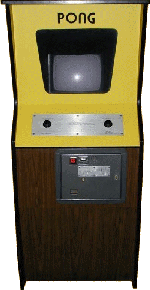
En 1972 Nolan Bushnell, ahora con su empresa Atari, adapta el mítico juego Pong para recreativa. Fué un éxito enorme. Las características má… ver más
En 1972 Nolan Bushnell, ahora con su empresa Atari, adapta el mítico juego Pong para recreativa. Fué un éxito enorme. Las características máquinas amarillas se fueron multiplicando y para millones de personas fué su primerísima experiencia con un videojuego
 Vanguard X-810
Subsidiaria de Cahue Industrial S.A., fabricante de radios, televisiomnes y otros electrodomésticos en los años 70. ver más
Subsidiaria de Cahue Industrial S.A., fabricante de radios, televisiomnes y otros electrodomésticos en los años 70.
 Waco Electro TicTacToe
Aunque Wacos Electronic Tic-Tac-Toe no es una consola de mano, si que represento el camino a seguir hasta la creación de estos dispositivos.… ver más
Aunque Wacos Electronic Tic-Tac-Toe no es una consola de mano, si que represento el camino a seguir hasta la creación de estos dispositivos. Como todo origen, hay discrepancias sobre si puede considerarse o no el primer juego electrónico. Tiene luces pero realmente no hay una lógica interna contra la que deba enfrentarse un jugador.
Waco Electro TicTacToe Timer
revisión con temporizador ver más
revisión con temporizador
Xerox PARC Mouse
Canon Canola P1211D
Casio Mini CM-602
Computer Derby
 IBM Selectric II
ITT Odyssee
Laser Clay Shooting System
The Laser Clay Shooting System (レーザークレー射撃システム) is a light gun shooting simulation game created by Nintendo in 1973. The game consisted of an… ver más
The Laser Clay Shooting System (レーザークレー射撃システム) is a light gun shooting simulation game created by Nintendo in 1973. The game consisted of an overhead projector which displayed moving targets behind a background; players would fire at the targets with a rifle, in which a mechanism of reflections would determine whether or not the laser shot from the rifle hit the target. The concept behind the Laser Clay Shooting System came from Hiroshi Yamauchi, while Gunpei Yokoi was behind the development of the system. It was released in deserted bowling alleys in Japan in 1973; upon release, it was a commercial success. However, the success of the system quickly evaporated as a result of the 1973 oil crisis and the ensuing recession in Japan, which left Nintendo ¥5 billion in debt and on the verge of bankruptcy. In 1974, Yamauchi, in an attempt to revive Nintendo, released a smaller, cheaper version of the Laser Clay Shooting System, titled Mini Laser Clay. Deployed mostly in arcades, players shoot moving targets, provided by a 16mm film projector, at an arcade cabinet. This system featured several games and achieved significant success for Nintendo throughout the mid to late 1970s, which helped the company out of its financial situation.
 Marx Games Magic Shot
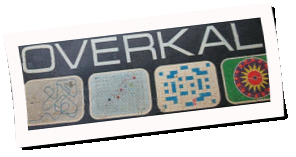 Overkal
Clon español no autorizado de la Magnavox Odyssey. Primera consola europea. La electrónica de la consola no utiliza circuitos integrados, s… ver más
Clon español no autorizado de la Magnavox Odyssey. Primera consola europea. La electrónica de la consola no utiliza circuitos integrados, solo componentes discretos.
 Sears Adding Machine 363A
 Texas Instrument SR-11
Texas Instrument TI-2500 Datamatch
Texas Instrument TI-3500
 Unitrex 1200
 Xerox Alto
The Xerox Alto is a computer designed from its inception to support an operating system based on a graphical user interface (GUI), later usi… ver más
The Xerox Alto is a computer designed from its inception to support an operating system based on a graphical user interface (GUI), later using the desktop metaphor. The first machines were introduced on 1 March 1973, a decade before mass-market GUI machines became available.
Casio FX-17
Casio Mini CM-604
Casio Mini Root
 Henrys VideoSport MK2
The VideoSport MK2 was sold in 1974 or early 1975 by Henrys, a British retailer of televison and Hi-Fi equipment. It is one of the earliest … ver más
The VideoSport MK2 was sold in 1974 or early 1975 by Henrys, a British retailer of televison and Hi-Fi equipment. It is one of the earliest European PONG systems and uses analog circuits. It was still available at Henrys in early 1977. Customers could either buy it in the stores, or have it sent by mail. The box of our specimen was shipped to its original owner in January 1977 and shows a hand-written 2819 in large digits. If this is a serial number, then less than 3000 specimens were sold in two years, which is very low. In this case, it is possible that only a few thousands of units were built. Seeing that sort of model being still sold and discounted in stores in 1977 was common back in the 1970s. The rush for the latest and more advanced model did not exist: although many advanced models were available, earlier ones were still proposed at a lower price (hence the discount between the two advertisements below and our boxed unit, originally purchased for £20.20). The hand assembled electronic circuit board is very basic: it has only two TTL integrated circuits containing four NAND gates each. The rest is made of discrete components. This is a typical design for an analog system released in small amount. The electronic circuit of this system is the simplest one after the Magnavox Odyssey. The system is only powered by the mains. Curiously, the bottom sides of the case and hand controls are glued rather than screwed, making it difficult to open the main unit without damaging the borders. Two versions are known to exist: the original one with gold letters, and the later one without gold letters (probably an attempt to reduce the production costs). The push-buttons could be black, yellow or white as these systems were mostly hand assembled with parts purchased on the fly, as opposed to systems made by bigger companies who ordered their whole stock of electronic parts because their products were assembled by automatic tools. The system plays three games without any difficulty level, although it would have been easy to adjust the ball motion, paddle size, etc. Such settings were common with analog systems.
Intel 4040
The Intel 4040 is the successor to the Intel 4004. It was introduced in 1974. The 4040 added 14 instructions, larger stack (8 level), 8K pro… ver más
The Intel 4040 is the successor to the Intel 4004. It was introduced in 1974. The 4040 added 14 instructions, larger stack (8 level), 8K program space, 8 more registers, and interrupt abilities. It was used primarily in games, instrumentation and point of sale terminals, development- and control equipment. The 4040 family is also referred to as the MCS-40.
Intel 8080
The Intel 8080 is an early 8-bit CPU, released in April 1974 running at 2 MHz, and is generally considered to be the first truly usable micr… ver más
The Intel 8080 is an early 8-bit CPU, released in April 1974 running at 2 MHz, and is generally considered to be the first truly usable microprocessor CPU design. It is the successor to the Intel 8008, with which it was assembly language source-compatible because it used the same instruction set developed by Computer Terminal Corporation. The 8080s 40 pin DIP packaging permitted it to provide a 16-bit address bus and an 8-bit data bus, allowing access to 64 kilobytes of memory. It has seven 8-bit registers (six of which could be combined into three 16-bit registers), a 16-bit stack pointer to memory (replacing the 8008s internal stack), and a 16-bit program counter. The 8080 had 256 I/O ports allowing I/O devices to be connected without the need to allocate memory space - as is required for memory mapped devices - but at the expense of having programmers deal with separate I/O instructions. The first single-board microcomputer was built on the basis of the 8080. The 8080 was used in many early computers, such as the MITS Altair 8800 and IMSAI 8080, forming the basis for machines running the CP/M operating system (the later, fully compatible and more capable, Zilog Z80 processor would capitalize on this, with Z80 CP/M becoming the dominant CPU OS combination of the period much like x86 MS-DOS for the PC a decade later). Shortly after the launch of the 8080, the Motorola 6800 competing design was introduced, and after that, the MOS Technology 6502 clone of the 6800. At Intel, the 8080 was followed by the compatible and electrically more elegant 8085, and later by the assembly language compatible 16-bit 8086 and then the 8/16-bit 8088, which was selected by IBM for its new PC to be launched in 1981. The 8080, via its ISA, thus got a lasting impact on computer history. The 8080 was very popular and was second-sourced by various manufacturers. Clones of the 8080 were also made in former Eastern Block countries like USSR, Poland, CSSR, Hungary and Romania.
Marx Games Electro Hockey
Marx TV Tennis
By the early 1970s the Marx Company had fallen on hard times. In 1972, Louis Marx sold his company to the Quaker Oats Company. Having largel… ver más
By the early 1970s the Marx Company had fallen on hard times. In 1972, Louis Marx sold his company to the Quaker Oats Company. Having largely ignored industry trends toward electronic toys, Quaker struggled to keep Marx going. In 1972, Marx attempted to capitalize on the success of Pong with a mechanical version called T.V. Tennis. Contrary to its name, T.V. Tennis could not be played on a television. Instead, Marx designed the plastic game to resemble a TV without any electronic components except a battery-powered motor and a glowing light bulb that acted as a tennis ball. Unfortunately for Marx, its mechanical Pong imitator was not a success. In 1976, Quaker sold its Marx division to a British conglomerate, who finally shutdown Marx and liquidated its assets in the early 1980s.
Marx TV Tennis brown
By the early 1970s the Marx Company had fallen on hard times. In 1972, Louis Marx sold his company to the Quaker Oats Company. Having largel… ver más
By the early 1970s the Marx Company had fallen on hard times. In 1972, Louis Marx sold his company to the Quaker Oats Company. Having largely ignored industry trends toward electronic toys, Quaker struggled to keep Marx going. In 1972, Marx attempted to capitalize on the success of Pong with a mechanical version called T.V. Tennis. Contrary to its name, T.V. Tennis could not be played on a television. Instead, Marx designed the plastic game to resemble a TV without any electronic components except a battery-powered motor and a glowing light bulb that acted as a tennis ball. Unfortunately for Marx, its mechanical Pong imitator was not a success. In 1976, Quaker sold its Marx division to a British conglomerate, who finally shutdown Marx and liquidated its assets in the early 1980s.
Maze Wars
Maze Wars se presentaba como un shoter en primera persona ambientado en un laberinto, dos décadas antes de Doom. ver más
Maze Wars se presentaba como un shoter en primera persona ambientado en un laberinto, dos décadas antes de Doom.
Motorola 6800
The 6800 processor was released by Motorola in 1974, shortly after the Intel 8080. It was the basic for Motorolas entrance into the micropro… ver más
The 6800 processor was released by Motorola in 1974, shortly after the Intel 8080. It was the basic for Motorolas entrance into the microprocessor market. Like the Intel 8080 it was designed as an enhancement of the Intel 8008 but is not technically based on it
Nintendo Wild Gunman
Pong Sears Atari
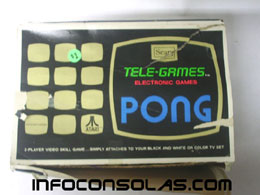
Despues de todo el trabajo y de hacer grandes inversiones para poder transformar una Coin-Up en una consola domestica, Atari estaba en una s… ver más
Despues de todo el trabajo y de hacer grandes inversiones para poder transformar una Coin-Up en una consola domestica, Atari estaba en una situación bastante dificil. Empezaron a negociar con Sears, una gran cadena de centros comerciales americana. Los responsabes de Sears se quedaron maravillados con la Atari Pong, y estaban interesados en comprarla, pero con una condición: Querian los derechos de la Atari Pong. Al trato que llegaron fue el siguiente, Sears les compraria las Pongs, pero tendrian exclusividad de venta y los derechos del producto durante un año. Y de esta forma se lanzo al mercado la Atari Pong, fabricada por Atari pero con el nombre de Sears Tele-Games. Es dificil de creer que una compañia de tal calibre como Atari haya tenido estos inicios, su primera consola domestica comercializada con otro nombre y vendida por unos grandes almacenes... Como si aqui hubiesen sacado la Corte Ingles Nes . Aun asi la consola fue un exito de ventas, en navidades de 1975 la gente hacia horas de cola tan solo para apuntarse a la lista de reservas. Sears vendio 150.000 unidades. Esta es la historia de la Atari Pong, un año despues Atari ya pudo sacar su propia consola domestica con el nombre de Atari Pong e identicas caracteristicas a la Sears Tele-Games. La verdad es que en Infoconsolas nos decantamos por llamarle Atari Pong, ya que es el nombre de la consola en si, pero el nombre comercial es Sears Tele-Games... ¿Quien fue antes, el huevo o la gallina?
RCA 1802
The COSMAC is an 8-bit microprocessor family introduced by RCA. It is historically notable as the first CMOS microprocessor. The first produ… ver más
The COSMAC is an 8-bit microprocessor family introduced by RCA. It is historically notable as the first CMOS microprocessor. The first production model was the two-chip CDP1801R and CDP1801U, which were later combined into the single-chip CDP1802. The 1802 represented the majority of COSMAC production, and today the entire line is known simply as the RCA 1802.
SCELBI-8H
SCELBI was an early model of microcomputer based on the Intel 8008 processor. The company SCELBI (derived from SCIentific-ELectronics-BIolog… ver más
SCELBI was an early model of microcomputer based on the Intel 8008 processor. The company SCELBI (derived from SCIentific-ELectronics-BIology) Computer Consulting in 1973, by Nat Wadsworth. The SCELBI 8H was marketed in 1974 and was delivered either as an assembled unit or as a kit, with five basic circuit boards and provision for memory expansion to 16 kB (16,384 bytes). The company offered input/output devices including a keyboard, teleprinter interface, alphanumeric oscilloscope interface, and a cassette tape interface for data storage. The basic system only used a front panel with 11 switches and LEDs for input and output. The company also offered a version of the BASIC programming language that ran on the platform, called SCELBAL. Optional modules for strings and transcendental functions allowed the system to operate in small memory configurations. SCELBAL was sold in book format, allowing it to be used on any similar 8008 or 8080 based platform. The initial model 8H was discontinued at the end of 1974 and an improved model 8B was introduced. Fewer than 150 board sets and assembled systems were ever sold. Later in 1975, the availability of systems based on the more flexible 8080 processor reduced demand for the slower 8008-based product. The company discovered that the demand for books on microcomputers was very high and published several books; the publishing business was sold in 1982.
 Sanyo CX-8108
Sharp SM5xx
Shot Racer
Tank
Atari, junto con Kee Games, realizó el primer videojuego que almacenaba los gráficos en chips de memoria Rom y que avanzaba también en otras… ver más
Atari, junto con Kee Games, realizó el primer videojuego que almacenaba los gráficos en chips de memoria Rom y que avanzaba también en otras características técnicas. Se trataba de dirigir un tanque en una especie de laberinto
Texas Instruments TMS1100 Microvision
 Videomaster Home TV Game VM577
Videomaster es unos de los primeros fabricantes de videojuegos en Europa, posiblemente el primero. Esta compañía establecida en Londres com… ver más
Videomaster es unos de los primeros fabricantes de videojuegos en Europa, posiblemente el primero. Esta compañía establecida en Londres comenzó en 1974 y entre 1974 hasta 1979 saco mas de 15 sistemas, algunos de estos sistemas iban en modo de kit de montaje, para los aficionados de electrónica y ahorrar algo de dinero
 Zanussi Ping-O-Tronic
Ping-O-Tronic es una consola de videojuegos producida por Zanussi (conocido fabricante de muebles) en 1975 con la marca Seleco. Los juegos … ver más
Ping-O-Tronic es una consola de videojuegos producida por Zanussi (conocido fabricante de muebles) en 1975 con la marca Seleco. Los juegos usados son sólo tres similares entre sí: tenis, squash y frontón. El 21 de abril de 1975 Zanussi obtuvo la licencia para poner en práctica el juego de Pong de Sanders Associates. Existieron muchas variantes de la Ping-o-Tronic, todas ellas de idéntico funcionamiento solo diferentes en cuanto a aspecto externo. La más conocida es el modelo PP-2 con su color naranja caracteristico, pero aparte existió los modelos PP-1, PP-3, PP-4 y a partir del modelo PP-5 hasta el PP-10, la maquina disponía de un puerto de 5 pines DIN que permitía incorporar la Gun-o-Tronic, que simulaba una escopeta. Zanussi creó una sub-empresa que supuestamente estaría encargada en un futuro de ser la filial de la marca dedicada a los videojuegos, esta empresa tenía el nombre de Seleco, por lo que no es dificil encontrar algún modelo de Ping-o-Tronic que en lugar de utilizar el logo de Zanussi tuviese el logo de Seleco (sobretodo en los modelos PP-4 y adelante), aunque existen algunos modelos que pueden llevar uno u otro indistintamente. Junto a la Magnavox Odyssey y Philips Tele-Spiel ES-2201 es una de las pocas consola que utilizan componentes discretos, en concreto la lógica de control se basa en tres chips 7400.
Zanussi Ping-O-Tronic PP5
Zanussi Ping-O-Tronic PP7
98000 in 1
AMD 8080
AMDs business in the 1970s was not the creation of new products; it concentrated on making higher quality versions of existing products unde… ver más
AMDs business in the 1970s was not the creation of new products; it concentrated on making higher quality versions of existing products under license. For example, all of its products met MILSPEC requirements no matter what the end market was. In 1975, AMD began selling reverse-engineered clones of the Intel 8080 processor. The AMD 9080A was a plug-in replacement for Intels 8080, an unauthorized second source. As a result of that AMD negotiated a technology cross-license and patent cross-license with Intel in 1975 and renamed the chip 8080A.
APF TV Fun 401A
Actimel
Airport
 Altair 8800
El MITS Altair 8800 es un microordenador de 1974 basado en el procesador Intel 8080. Tras aparecer en la portada de la revista Popular Elect… ver más
El MITS Altair 8800 es un microordenador de 1974 basado en el procesador Intel 8080. Tras aparecer en la portada de la revista Popular Electronics en diciembre de de 1974, el interés por esta máquina empezó a crecer muy deprisa. Los creadores estimaban unas ventas de unos cientos de unidades, pero en el primer mes ya se superaban varios miles. Se considera al Altair el iniciador de la revolución de los mocroordenadores. El primer lenguaje de programación de esta máquina, Altair BASIC fué además el primer producto de Microsoft.
Ami S2150
S2000 is a family of 4-bit microcontrollers manufactured by American Microsystems, Inc (AMI) in the first half 1980. Depending on part numbe… ver más
S2000 is a family of 4-bit microcontrollers manufactured by American Microsystems, Inc (AMI) in the first half 1980. Depending on part number, 2000 or 215x, the microcontroller had either 32 or 40 byte on-chip scratchpad RAM, and 1 KB or 1.5 KB ROM.
Amidar
Animal Imaginado
Astro Chicken
Atari 3659-1C
Atari 3659-3
Atari Touch Me
Atari Ultra Pong Doubles
Atari Video Pinball
Bambino Race and Chase
Bambino Safari
Bambino Soccer Kick the Goal
Bambino Space Laserfight
Bambino UFO Master Blaster
Baseball
 Basketball
Bestech Frog
Burger King Plant VS Zombies
Car Racing
Casio FX-15
Casio Memory-10F
Casio Memory-8S
Casio Mini 8-Y800
Computer Beam Gun Professional
 Conic TV Color Sport TVG-406-6
Conic TV Sports TG-621
Conic TVG-4010-6
Cowboy Rodeo
Cragstan Periscope-Firing Range
E-Star Super Brick Game
Epoch Electrotennis
Electrotennis (o TV Tennis en japones) es la primera consola creada y vendida en Japon por una empresa japonesa, aunque anterior a esta se c… ver más
Electrotennis (o TV Tennis en japones) es la primera consola creada y vendida en Japon por una empresa japonesa, aunque anterior a esta se comercializaban diferentes tios de pong. Antes que la Cassette Vision o TV Vader, Epoch fabricó esta consola inalámbrica, que funciona con pilas y envía la señal a través de una antena separada que se conecta al televisor. A diferencia de los clasicos pongs, dispone de cierta inteligencia artificial, que permite jugar a un solo jugador, además de dobles. Por otra parte, el palito puede moverse a izquierda y derecha, no solo arriba y abajo. Utiliza un contador manual de puntos.
Epoch Fights of the Titan
Epoch Galaxy II
Epoch Mogura Punch
Epoch Tv Block
Epoch Zig Zag Monster
Excalibur Gin Rummy
 Executive Games Television Tennis
De diseño simple, este raro pong tiene la virtud de permitir jugar contra la máquina, tanto uno como los dos jugadores ... lo que la convier… ver más
De diseño simple, este raro pong tiene la virtud de permitir jugar contra la máquina, tanto uno como los dos jugadores ... lo que la convierte en un sistema salvapantallas del pong! If Atari and Magnavox had funds to design complete lines of video games, there were other small businesses that tried to enter the market as they could. Executive Games is a great example. Executive Games Inc. of Dorchester, Massachusetts was incorporated in 1968 under the direction of owner Peter Stepanek. Games and novelty items, such as chess and backgammon, were the companys original product line. Foot-high chessmen and a plush checkered playing surface rug evidenced the unique and novel appeal of one chess set. By 1974, yearly sales had grown to $2-million and the company was on the verge of a major two-fold product expansion. Executive Games became one of the leading producers of home video games by January 1976. The electronic games market flourished in late 1975 as a major development in the consumer electronics industry, following hand-held calculators and digital watches. Until then high costs had restricted video games to coin operated machines in public areas. Peter Stepanek recruited the engineering skills of a group of M.I.T. students to develop a less expensive version of these popular games: Gabor Szakacs, Robert Dickson, Mike Shields, Glen Dash, David Agans, and Joseph Corkery. Glen Dash continued working on video games after the Executive Games plant closed in 1976. He was another key person in this field, not only for his unique competences in FCC testing, but also as an engineer. More details can be found at the end of this page about the works of Glen Dash. The company released two video game systems in 1975 and 1976: Electronic Television Tennis and Face Off (TV Hockey/Soccer). Electronic Television Tennis was the third American home video game system (excluding URL Video Action II and III. See why on the URL page). It passed the FCC tests only a month after Atari Pong and began selling in the fall of 1975. Executive Games continued to sell Television Tennis until October 1976. Despite being a small company, Executive Games managed to sell approximately 65,000 Television Tennis games during that time (Magnavox produced 140,000 Odyssey units in 1972, and only around 60,000 in 1975). Approximately 18,000 Face Off units were produced and approximately 13,000 units were sold between October and December 1976. The remaining 5000 units were either sold as surplus in 1977 or went missing in a robbery of the Executive Games Dorchester, Massachusetts plant just before the close of the 1976 Christmas season. The whole history of Executive Games is detailed in a well-written business case study authored by an MIT student, Victor Tom, in 1977. Glen Dash, one of the MIT students who developed Television Tennis, made corrections to this document and sent it to us. Click here to read it. (It is in a PDF format so you may need to download the Adobe Acrobat Reader to view it.) Once you have read the PDF document, you might wonder why Executive Games did not design a single video game chip to lower the cost of their units and bring more advanced games. Here is the answer, which Glen Dash emailed us in March 2003: As far as I can remember, the chips that Atari and GI were making were the most complex LSI devices that, up until that time, had been designed for the consumer market. Though we knew of GIs intentions in 1975, we did not think that they could produce something on the order of six million of these devices in 1976 and early 1977. That was quite a remarkable performance. Secondly, timing in the games market is very tricky, and dangerous. While public demand greatly exceeded supply in 1975 and 1976, I am not sure if that was the case by Christmas of 1977. Anyone stuck with inventory when demand dried up would have been killed. I agree that we had a window in which to produce chips in 1976 and early 1977, but being successful in the games market in late 1977 and 1978 would have required extraordinary vision. (As I am sure you know, hand held games were a rage for a while and then Mattels Intellivision and Ataris microprocessor based video game fought it out until the early 1980s. But thats a story for another time.)
Fairchild F8
In April 1975 Fairchild began sampling the F8 processor with production quantities available in the fall of 1975. Fairchild knew the import… ver más
In April 1975 Fairchild began sampling the F8 processor with production quantities available in the fall of 1975. Fairchild knew the importance of having second sources available and in June 1975 reached an agreement with Mostek to allow Mostek to produce the F8 as well. The 10 year agreement with Mostek included complete mask set transfers as Mosteks NMOS isoplanar process was completely compatible with Fairchilds. The agreement also called for continuing development of the F8 processor system, allowing each company to develop F8 products independently of each other as well as together (this is important down the road). Mostek was able to rapidly produce the F8 system, faster, cheaper, and more reliable than Fairchild. The F8 introduction price was $130 per unit. When Mostek began production in 1975 prices were down to $85 per unit. In February 1976 Mostek lowered prices to $55 per unit ($64 to $28 if you bought more than 100 pieces). The F8 was also licensed to SGS-Ates of Italy in 1976. Also in February of 1976 Fairchild signed a agreement with Olympia Werke A.G., a German company, allowing production and sharing of information on the F8 processor. It also allowed Fairchild (and any of its second sources, including Mostek) to use any of Olympia’s processor technology and products. So why did Fairchild reach such an agreement with Olympia, a relatively small company? Because General Instruments was suing Fairchild at the time
 First Dimension Video System FD-3000W
Esta maquina solo se vendía por correo The system was designed in 1975, so could only use CMOS or TTL logic gates. About 50 CMOS chips were… ver más
Esta maquina solo se vendía por correo The system was designed in 1975, so could only use CMOS or TTL logic gates. About 50 CMOS chips were used by the system in addition to the other discrete components (capacitors, etc). The games were also different from most others of the same period: the system played Tennis (2 or 4 players), Hockey (2 or 4 players) and Robot (1 or 2 players against machine). Tennis was the usual PONG variant. The 4-player mode split the screen horizontally in two parts so that two groups of two players could play at the same time. This was a unique feature. Hockey did not split the screen when used in 4-player mode, so the game consisted in two teams of one or two players. Robot is the most uncommon PONG variant. The game is played against the machine by one or two players. The goal is to make the ball go in the hole located on the machines side. To avoid this, the machine moves up and down a larger paddle to bounce the ball back to the players side.
GMan
Gakken Circus
 Gakken EX-System
The Gakken EX-System is a series of educational electronics kits produced by Gakken in the late 1970s. The kits use denshi blocks (also know… ver más
The Gakken EX-System is a series of educational electronics kits produced by Gakken in the late 1970s. The kits use denshi blocks (also known as electronic blocks) to allow electronics experiments to be performed easily and safely. Over 25 years after its original release, one of the main kits from the series was reissued in Japan in 2002.
Gakken Frogger
Gakken Galaxy Invader 1000 CGL
Gakken Galaxy Invader 1000 HISCORE
Gakken Invader 2000
Gakken Puck Monster
Gakken Runaway
Gakken SuperPuck Monster
Game Baloncesto
Game Coches
Game JungleBoy
Game Police
Game Turtle
General Instrument CP1610
The CP1600 is a 16-bit microprocessor created in a partnership between General Instrument and Honeywell in 1975. The CP1600s design was base… ver más
The CP1600 is a 16-bit microprocessor created in a partnership between General Instrument and Honeywell in 1975. The CP1600s design was based on the PDP-11, whose design also formed the basis of the Western Digital MCP-1600 and influenced others. Honeywell used the CP1600 in a number of process control computers and related systems, but its most widespread use was the CP1610 version in the Intellivision video game console.
Grandstand Munchman
Grandstand TV Game 3600
Great Savanna
Guitar Hero
Gunfight
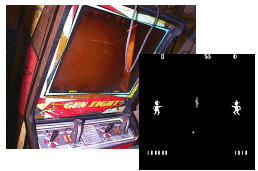
Gunfight fué el primer juego japonés que fué licenciado para su venta en America, Midway rediseñó la versión original y usó por primera vez … ver más
Gunfight fué el primer juego japonés que fué licenciado para su venta en America, Midway rediseñó la versión original y usó por primera vez en la historia un microprocesador en una máquina arcade. El juego trataba de emular los duelos típicos de las películas del oeste y era para dos jugadores.
Hand Held 1
Hand Held 2
Heli-Battle
Henrys Videosport Mk2 sin letras doradas
Hungry Pac
IBM 5100 Portable PC
The Model 5100 is IBMs first minicomputer, i.e. not a mainframe, and is also considered one of the worlds first portable computers. It is pr… ver más
The Model 5100 is IBMs first minicomputer, i.e. not a mainframe, and is also considered one of the worlds first portable computers. It is preceded only by the Hewlett-Packard HP-9830A from 1973. Although at 55-pounds, the 5100 might best be described as self-contained rather than portable.
 Interton Video 2000
El primero de los numerosos pongs lanzados por la empresa alemana Interton en 1975, que culminaría con el desarrollo de la conocida (en euro… ver más
El primero de los numerosos pongs lanzados por la empresa alemana Interton en 1975, que culminaría con el desarrollo de la conocida (en europa) consola Interton VC 4000, y uno de los primeros sistemas europeos en utilizar cartuchos para cambiar de juego. Como el Philips Tele-Spiel, la máquina dispone de un adaptador para ajustar la imagen, en lugar de tener que hacerlo en el televisor, además se encendía automáicamente al detertar la inserción de un juego. En la fecha de creación no estában aún disponibles los pong-on-chip, por lo que se utilizaron 14 integrados CMOS que dibujaban los elementos básicos de cada juego: linea central, jugadores y pelota, además de generar algunos sonidos. Los cartuchos podían configurar estos integrados para añadir elementos gráficos adicionales, detectores de colisión y reglas de juego adicional, que permitían crear nuevos juegos. Se puede considerar que está a un nivel intermedio entre la Odyssey (los cartuchos configuran los cirtuitos internos de la máquina con unos pocos integrados) y la Philips Tele-Spiel ES-2201 (los cartuchos incluyen componentes electrónicos adicionales para la definición de los juegos). Se conocen 5 cartuchos de juegos, aunque en algunas imágenes se muestran dos más, Car Race y Naval Battle, que no llegaron a desarrollarse probablemente debido a su complejidad alejada de los típicos pong. Como no podía ser de otro modo, en España se desarrolló un clon de la Interton Video 2000, el Togisa Teletenis Multijuegos, que también mostraba en las instrucciones dos juegos (carrera de coches y bombardero naval) que no llegaron a desarrollarse-copiarse. Lo que si se hizo fue quitarle el cable de conexión al televisor y colocarle a la máquina una antena que emitía directamente la señal hasta la tele ... con dos cojones.
LCD Bob Esponja
LCD Bob Esponja Gary
LCD Musica
LCD Racing Car
LSI Defender
LSI Shark Hunter
Lexibook Motorcycle
Lexibook Space Invaders
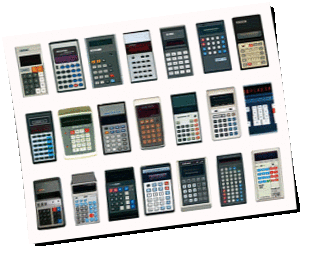 Logitech Mini
MOS Technology 6502
The 6502 is an 8-bit processor designed by MOS Technology in 1975, based on the design of the Motorola 6800. When it was introduced it was t… ver más
The 6502 is an 8-bit processor designed by MOS Technology in 1975, based on the design of the Motorola 6800. When it was introduced it was the least expensive full featured CPU on the market by far, at about 1/6th the price, or less, of competing designs from larger companies such as Motorola and Intel. It was nevertheless faster than most of them, and, along with the Zilog Z80, sparked off a series of computer projects that would eventually result in the home computer revolution of the 1980s. The 6502 design was originally second-sourced by Rockwell and Synertek and later licensed to a number of companies; it is still made for embedded systems. Unlike the Intel 8080 and its kind, the 6502 had very few registers. It was an 8-bit processor with 16-bit address bus. Inside was one 8-bit data register (accumulator), two 8-bit index registers and an 8-bit stack pointer. When the 6502 was introduced, RAM was actually faster than CPUs, so it made sense to optimize for RAM access rather than increase the number of registers on a chip. 6502 processors were used in a variety of home computers of the early 80s, for example in: Commodore PET and VC20 Apple I, II and III Atari 400, 800, 600/800XL Acorn Atom and Electron
MOS Technology 6507
The 6507 is an 8-bit microprocessor from MOS Technology, Inc. It is a version of their 6502 packaged in a 28-pin DIP, which makes it cheaper… ver más
The 6507 is an 8-bit microprocessor from MOS Technology, Inc. It is a version of their 6502 packaged in a 28-pin DIP, which makes it cheaper to package and integrate in systems. The reduction in pin count is achieved by reducing the address bus from 16 bits to 13 (limiting memory from 64 kB to only 8 kB), and removing a number of other pins only needed in certain applications.
 Magiclick 350
 Magnavox Odyssey 100
La Odyssey 100, versión simpplificada de la Odyssey, aparecio en 1975, tres años después de la Original. Usa un diseño basado en cuatro chip… ver más
La Odyssey 100, versión simpplificada de la Odyssey, aparecio en 1975, tres años después de la Original. Usa un diseño basado en cuatro chips discretos de TI, siendo así el más simple de los modelos desarrollados por Magnavox. Aunque la compañía tenía en mente el diseño basado en un solo chip para mediados de ese mismo año, no querían arriesgarse a que Texas Instruments, el suministrador del chip de video, sufriera algún retraso en la entrega del mismo. Tenía dos juegos (Tennis y Hockey), siendo el primero inspiración directa del Pong. Ninguno de los dos tenía contador en pantalla, pero emitía un sonido algo desagradable cuando un jugador perdía el punto. Se alimenta de seis baterias tipo C o un adaptador de 9VAC Cada jugador tiene dos botones para el desplazamiento horizontal y vertical y un tercero para ajustar la trayectoria de la bola.
Magnavox Odyssey 200
La Odyssey 200, de 1975, ya utilizó el diseño basado en un chip de TI. Además de Tenis y Hockey, añadía un tercer juego, Smash, siendo la pr… ver más
La Odyssey 200, de 1975, ya utilizó el diseño basado en un chip de TI. Además de Tenis y Hockey, añadía un tercer juego, Smash, siendo la primera consola que permitía jugar a dos o a cuatro jugadores simultaneamente. Añadió un contador en pantalla, representado por un cuadro que cambiaba de posición cada vez que se hacía un punto. La alimentación y los mandos son similares al modelo anterior.
Manley Toy MotorCycle
Megatrix Space Invaders
Melody 20 Level Runaway
Mini Arcade - Submarine
Mini Poli Ztation2001
Mirada Fighters
Mission Nanny
Money Bomb
 Mx Onda
Namco Varie Dragon Spirit
NeoDouble Games
Nineteendot LCD
Novax 8003M
 Ohio Scientific Challenger 1P
Ohio Scientific Inc. (also known as Ohio Scientific Instruments) was an Ohio-based computer company that built and marketed microcomputers f… ver más
Ohio Scientific Inc. (also known as Ohio Scientific Instruments) was an Ohio-based computer company that built and marketed microcomputers from 1975 to 1981. Their best-known products were the Challenger series of microcomputers and Superboard single-board computer kits.
Olympia Werke CD40
PEP Station
PS GR368 Fighter Game
Pac-Man
 Parker Tennis Card Game
 Philips Tele-Spiel ES2201
Con permiso de nuestra española Overkal (copia simplificada y mejorada de la Magnavox Odyssey, según el propio Ralph H. Baer), esta máquina … ver más
Con permiso de nuestra española Overkal (copia simplificada y mejorada de la Magnavox Odyssey, según el propio Ralph H. Baer), esta máquina de fabricación holandesa puede considerarse una de las primeras consolas europeas, al utilizar cartuchos para los diferentes juegos, en lugar de un solo integrado, como los pongs. Creada por Philips en 1975, esta curiosa consola tiene una serie de particularidades que dan a entender lo perdidos que andaban los diseñadores en aquellos primeros años, respecto a las características que acabarían compartiendo el resto de consolas. En lugar de utilizar un canal fijo de televisión, dispone de una rueda de control para emitir en un reducido espectro de canales, de modo que, en lugar de sintonizar a televisión, simplemente se gira la rueda hasta que la imagen aparece en pantalla. Internamente se puede ajustar algo más el rango de canales en los que emite. La otra rueda de control de la consola permite definir la dificultad del juego, lo que básicamente hace es aumentar la velocidad (de la pelota en el caso del juego de tenis). El contador de puntos, hasta 15, para uno o dos jugadores, también se encuentra en la propia consola, siendo totalmente digital (hay que moverlo con el dedo). Los mandos de control se insertaban ... en el cartucho !!!
Pin Ball
Ping Pong Retro
Pirate
Play Time Bear Salmon
Pocket Boy Motor Cycle
PowerRangers
QQ-CBM Caveman
QQ-CBM Island
QQ-CBM Run Away
QQ-CBM Time Warp
Radio Shack TV Scoreboard - Model 60-3060
Sanyo CX-8007
Sanyo CX-8073
Sanyo CZ-8106
Sears F86
 Sears Tele-Games Pong
En 1975, los fabricantes de productos electrónicos y juguetes no estaban interesados en el sistema Pong. Uno de los directivos de Atari deci… ver más
En 1975, los fabricantes de productos electrónicos y juguetes no estaban interesados en el sistema Pong. Uno de los directivos de Atari decidió contactar con Tom Quinn, de Sears/Roebuck Tras varios encuentros con Bushnell, Sears pidió 150.000 máquinas para navidad, que fueron vendidas con su propio sello Sears Tele-Games. clon Atari Pong Modelo 25796
Sears Tele-Games Super Pong IV
Sega Mcdonalds 1
Sega Mcdonalds 2
Sega Mcdonalds 3
Sega Mcdonalds 4
Sega Mcdonalds 5
Sega Mcdonalds 6
Sega Mcdonalds 7
Seleco Ping-O-Tronic
 Sharp Elsi Mate EL-8009S
Shinsei Blastergame
Shogun
Signetics 2650
SmartPlayer
SoccerSport
Soundic Programable TV-Game SD-050
Soundic SD-04 TVSport color
Soundic SD-062 TV-18
Soundic SD-070C Sport
Soundic TVG SD-01
Soundic TVG SD-01 azul
Star War
Star Wars Empire Strikes Back
Star Wars Return Of The Jedi
StreetFighter
Studio-TC-Spiel ES2201
Tele-Peli ES2201
Telepizza
Telespel ES2201
Página 1 de 22