Timeline
La historia completa: lanzamientos, quiebras, inventos y momentos clave de la industria, década a década.
Mostrando eventos 1751–2000 de 5387.
 Fountain Force 2
 Funtronics Hot Wheels Drag Race
Mattels Funtronics games (Jacks, Red Light Green Light, Tag and Hot Wheels Drag Race) ver más
Mattels Funtronics games (Jacks, Red Light Green Light, Tag and Hot Wheels Drag Race)
Funtronics Jacks
Mattels Funtronics games (Jacks, Red Light Green Light, Tag and Hot Wheels Drag Race) ver más
Mattels Funtronics games (Jacks, Red Light Green Light, Tag and Hot Wheels Drag Race)
Funtronics Red Light Green Light
Mattels Funtronics games (Jacks, Red Light Green Light, Tag and Hot Wheels Drag Race) ver más
Mattels Funtronics games (Jacks, Red Light Green Light, Tag and Hot Wheels Drag Race)
Funtronics Tag
Mattels Funtronics games (Jacks, Red Light Green Light, Tag and Hot Wheels Drag Race) ver más
Mattels Funtronics games (Jacks, Red Light Green Light, Tag and Hot Wheels Drag Race)
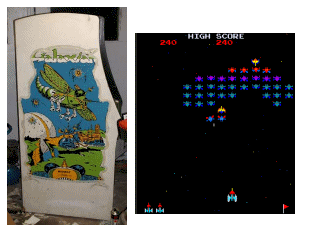
Galaxian
Namco con este juego disfrutó de un gran éxito, los juegos mata-marcianos estaban de moda y Galaxian tenía una jugabilidad y una adicción mu… ver más
Namco con este juego disfrutó de un gran éxito, los juegos mata-marcianos estaban de moda y Galaxian tenía una jugabilidad y una adicción muy elevada. El novedoso empleo del color le daba un mayor aliciente y el juego de las moscas o Fium fium se extendió por todo el mundo.
 Hanimex HMG-1292
Hanimex HMG-1392
Horoscope Computer
Horse Race Analyzer
 Intel 8088
The Intel 8088 (eighty-eighty-eight, also called iAPX 88) microprocessor is a variant of the Intel 8086. Introduced on June 1, 1979, the 808… ver más
The Intel 8088 (eighty-eighty-eight, also called iAPX 88) microprocessor is a variant of the Intel 8086. Introduced on June 1, 1979, the 8088 had an eight-bit external data bus instead of the 16-bit bus of the 8086. The 16-bit registers and the one megabyte address range were unchanged, however. In fact, according to the Intel documentation, the 8086 and 8088 have the same execution unit (EU)—only the bus interface unit (BIU) is different. The original IBM PC was based on the 8088, as were its clones.
 Intel Universal Tele-Play
 Interact Home Computer System
The Interact computer had a very short life in USA. It had only just got in production when the Interact Co. of Ann Arbor MI, went bankrupt.… ver más
The Interact computer had a very short life in USA. It had only just got in production when the Interact Co. of Ann Arbor MI, went bankrupt. Several thousand machines were produced though. Some of them were sold by Protecto Enterprizes of Barrington, IL, the liquidator, but the main part was sold by MicroVideo, also of Ann Arbor. Protecto bought lots of back-of-the-magazine ads for years, always printed with WE LOVE OUR CUSTOMERS. The Interact shipped with 2 joysticks, a built-in tape recorder, a TV RF modulator and 2 KB of ROM. Everything, including BASIC, must be loaded from tape. A little trivia: The tape unit did include an erase head, but it was not connected! Tapes had to be erased on a regular cassette recorder before being reused. Another surprising feature is that the 1 key is after the 0 key at the far right of the keyboard. Thus the row is starting from 2 and finishing by 1... See explanation in the Read more page. MicroVideo supported the machine for two years, 1979-80, making some hardware expansions (32K RAM card and stringy floppy drive), replacing the original minimalist EDU-BASIC language with a Microsoft 8K graphic version, and even publishing 3 issues of Interaction, a newsletter of the Detroit Interact Group. The Interact computer finally vanished from the US market in late 1980. However, a French company bought the rights of the machine and started to sell the Interact under Victor Lambda name in French market. See the rest of the story here. In 1980, Lambda System starts to sell the Interact computer without even changing its name. The documentation is in english and the computer is sold with a NTSC television ! Thus, since nothing was changed inside the Interact, it is still an NTSC computer ! Later the same year, Lambda System manages to implement a video card inside the system so the video output becomes SECAM via a Scart plug. At the same time, they put the power supply unit into the system, just under the tape storage comparment, above the tape recorder. This small space is now closed by a small grid that lets the heat of the PSU dissipate.
 Jostykit Multi TV Game HF 344
 Kingsford Match Me
 Korting Tele-Video-Computer TVC 4000
 Lakeside Computer Perfection
Ralph Baer ver más
Ralph Baer
 Lansay 1392
 MB Microvision
La Milton Bradley Microvison, fue una consola portátil de videojuegos, que usaba cartuchos intercambiables. Fue lanzada en 1979 por la jugue… ver más
La Milton Bradley Microvison, fue una consola portátil de videojuegos, que usaba cartuchos intercambiables. Fue lanzada en 1979 por la juguetera norteamericana, MB, en 1979 y dejó de fabricarse en 1982. La Microvision fue diseñada por Jay Smith, el ingeniero el cual más tarde diseño la consola de juegos Vectrex. La combinación de portabilidad y un sistema basado en cartuchos llevó a la Microvision a tener un éxito moderado, y a Smith Smith Engineering a recaudar cerca de $8 millones en el primer año del lanzamiento del sistema. La portátil incluso apareció en la película Viernes 13 parte 2. Sin embargo, muy pocos cartuchos, una pequeña pantalla, y la falta de apoyo de las empresas de videojuegos llevó a su desaparición. 1979 Block Buster 1- Block Buster o Casse Brique (Pack-in game) (4971) Bowling - 2- Bowling (Verde) (4972) Connect Four - 5- 4 Gewwinnt o Puissance 4 o Vier Op n Rij o Forza 4 (Azul) (4975) Pinball - 4- Pinball o Flipper (Amarillo) (4974) 1979 Mindbuster Star Trek: Phaser Strike 3- Shooting Star (Naranja) o Cannon Phaser (4973) Vegas Slots 1980 Baseball Sea Duel - Bataille Navalle o See-Duell o Duel (6 Gris) (4976) 1981 Alien Raiders - Blitz or Space Blitz (7 Marron) (4977) Cosmic Hunter 1982 Super Block Buster or Super Casse Brique (8 Negro) (Released only in Europe) (4978) Las versiones de cartuchos europeas están numeradas y tienen un color específico idéntico, cambiando solo el nombre en función del idioma. La versión de UK tiene texto diferente texto que la versión USA Las versiones de Canada tienen los mismos nombres que las de Francia, pero las cajas son del estilo de las de US. AUSTAUSCHBARE CASSETTE = Germany CARTUCCIA INTERCAMBIABILE = Italy CASSETTE INTERCHANGEABLE = France VERWISSELBARE CASSETTE = The Netherlands
 MBO 3010
 Magiclick Teleclick
Magiclick Teleclick ESP
Variante fabricada y vendida en España ver más
Variante fabricada y vendida en España
Maniac Electronic Game
Ralph Baer, el padre de los videojuegos, se embarcó en el negocio de desarrollo de juegos electrónicos en 1975, empezando a trabajar con la … ver más
Ralph Baer, el padre de los videojuegos, se embarcó en el negocio de desarrollo de juegos electrónicos en 1975, empezando a trabajar con la prolífica empresa de diseño de juguetes Marvin Glass Associates. El primer resultado de esta colaboración fue el conocido Simón. Tras el éxito de este, Marvin pidió a Baer que diseñara otro juego basado en el mismo concepto de luces y sonidos. Así surgió Maniac, que empezó a ser fabricado por Ideal Toy Company en 1979. Es un juguete electronico para cuatro jugadores, basado en cuatro desafíos de luces y sonidos que se repiten durante tres rondas hasta que uno de los jugadores alcanza una puntuación de 25. El propio Baer adminitió en una entrevista que el juego es realmente complicado, lo que explica que ni por asomo alcanzara el éxio de Simon.
 Meister Anker Slot Machine
 Micromat
Anunciado como micro-ordinateur de jeux, fonctions universelles, es una mezcla de microordenador, ajedrez y videojuego. Usa la misma carcasa… ver más
Anunciado como micro-ordinateur de jeux, fonctions universelles, es una mezcla de microordenador, ajedrez y videojuego. Usa la misma carcasa que Combat Lunaire, aunque de color negro.
Motorola 68000
The Motorola 68000 (sixty-eight-thousand; also called the m68k or Motorola 68k, sixty-eight-kay) is a 16/32-bit CISC microprocessor, introdu… ver más
The Motorola 68000 (sixty-eight-thousand; also called the m68k or Motorola 68k, sixty-eight-kay) is a 16/32-bit CISC microprocessor, introduced in 1979 by Motorola Semiconductor Products Sector.
 National TY-TG40
 Nec Compo BS80
The NEC TK 80 is a 8080-cpu Training Kit (hence the TK) computer sold at the end of the 70s. It is considered the first japanese home-comput… ver más
The NEC TK 80 is a 8080-cpu Training Kit (hence the TK) computer sold at the end of the 70s. It is considered the first japanese home-computer. It was firstly aimed at technicians, but it met a great success with first computer hobbyists. It was often sold as a kit. The systems is directly programmed in machine-code through the hexadecimal keyboard. There are 9 function keys on this keyboard : RET, RUN, STORE DATA, LOAD DATA, RESET, ADRS SET, READ INCR, READ DECR, WRITE INCR. Information is displayed on the built-in 7-segments LED display (1 line, 8 characters). The TK-80E is low-cost TK-80. The CPU and some chips are slightly different (uPD8080AD - uPD8080AFC, uPD8228D - uPD8228C, uPD454D - uPD464C, uPD5101E - uPD2101AL-4), thus reducing the production cost (ceramic - plastic). Of course the TK-80E was less expensive. The TK-80 BS was a Basic Station model. It was composed of a TK-80 board with a BASIC ROM built-in, 7k RAM and an alphanumeric keyboard. Furthermore there was the Compo BS/80 which was a TK-80 with its Basic extension within a nice moulded plastic case. The TK-80 was used as a base for the PC-8001, the PC-8801 and the PC-9801.
 Nec PC-8001
The PC-8000 series was a line of personal computers developed for the Japanese market by NEC. The PC-8001 model was also sold in the United … ver más
The PC-8000 series was a line of personal computers developed for the Japanese market by NEC. The PC-8001 model was also sold in the United States [2] and in the UK as the PC-8001A.[3] The first member of the PC-8000 series, the PC-8001 went on sale September 28, 1979 for ¥168,000.[1] Its design combined the keyboard and the mainboard into a single unit. At a time when most micro-computers were sold as semi-kits requiring end user assembly, the fully assembled PC-8001 was a rarity in the market. Peripherals included a printer, a cassette tape storage unit, and a CRT interface. Although it is often believed to be the first domestically produced personal computer for the Japanese market, in reality it was preceded by the Hitachi Basic Master. The information here is incomplete. Aside from the Wedge which was sold by a third party, NEC itself sold a number of addon units. The 32k RAM keyboard-shaped PC-8001A was the main micro computer, with everything built into the keyboard case $ a design similar to the Commodore 64 or he Atari 400 or 800 or Atari ST. But NEC also made and sold the PC-8031A mini disk unit, which allowed up to four half-height floppy disc drives to be installed. These were DSDD drives with 360K capacity each, so by installing 4, you got an instant storage capacity of up to 1.44 megs on drives A: and B: and C: and D:. The PC-8031A was an external beige box in which you could install the floppy drives. It had a built-in floppy drive controller and connected to the keyboard computer by a cable. Then there was the PC-8012A I/O unit. This contained serial and parallel ports as well as a primitive analog sound I/O similar to the creative sound blaster. Again, this was a beige box that also connected to the main keyboard computer through a cable, or it could connect to the 8031A floppy drive unit via a pass-through port. Finally, NEC sold the JC-1202DH(A) color character display, which uew the exact same chassis and cabinet and power supply as the earlier NEC green screen monochrome monitor but with color circuity. It was a simple analog monitor, no different from the Commodore or Apple color monitors. You could use any analog color monitor with this computer. As with the C64 or the Apple $$, the color monitors were interchangeable. NEC also sold its own particular brand of dot matrix printer with this computer. It used a standard Centronics (today we call it a parallel) port. You had to have the 8031A drive unit to load drivers for the NEC printer and run the software. Im not sure whether the I/O unit came with an extra 32K of RAM on a board inside the beige box, but I think so. If memory serves, this thing ran Wordstar and the NEC printer was EPSON-compatible, so you could use EPSON printer drivers and output the usual graphics text using escape and control characters to produce primitive block graphics. This unit was very impressive for its time. It cost a lot for all 3 units $ you stacked the two beige boxes up on top of one another and put the NEC monitor on top of those, then hooked them up via cable to the keyboard computer and hung the dot matrix printer (and a Hayes serial modem if you wanted) off the back of the I/O module. But if you paid the money and set it all up, you had a very fully functional machine that could connect to a BBS at 300 baud, print out properly formatted documented using standard dot matrix graphics text, play 8-bit sounds, and you had many of the same capabilities of the later EGA monitors with a variety of different colors. The disk drives were particularly good. They didnt go bad, unlike the full-height Tandon drives on earlier computers like the Kaypro II or the TRS-80. Those full-height 48 TPI Tandons used in earlier computers were notorious for drifting out of alignment, but the 96 TPI DSDD NEC floppy drives never went bad. If you find one of these units with the floppy drive module in storage and fire it up, chances are it will still boot and work.
Nec TK 80
The NEC TK 80 is a 8080-cpu Training Kit (hence the TK) computer sold at the end of the 70s. It is considered the first japanese home-comput… ver más
The NEC TK 80 is a 8080-cpu Training Kit (hence the TK) computer sold at the end of the 70s. It is considered the first japanese home-computer. It was firstly aimed at technicians, but it met a great success with first computer hobbyists. It was often sold as a kit. The systems is directly programmed in machine-code through the hexadecimal keyboard. There are 9 function keys on this keyboard : RET, RUN, STORE DATA, LOAD DATA, RESET, ADRS SET, READ INCR, READ DECR, WRITE INCR. Information is displayed on the built-in 7-segments LED display (1 line, 8 characters). The TK-80E is low-cost TK-80. The CPU and some chips are slightly different (uPD8080AD - uPD8080AFC, uPD8228D - uPD8228C, uPD454D - uPD464C, uPD5101E - uPD2101AL-4), thus reducing the production cost (ceramic - plastic). Of course the TK-80E was less expensive. The TK-80 BS was a Basic Station model. It was composed of a TK-80 board with a BASIC ROM built-in, 7k RAM and an alphanumeric keyboard. Furthermore there was the Compo BS/80 which was a TK-80 with its Basic extension within a nice moulded plastic case. The TK-80 was used as a base for the PC-8001, the PC-8801 and the PC-9801.
Nec TK 80BS
The NEC TK 80 is a 8080-cpu Training Kit (hence the TK) computer sold at the end of the 70s. It is considered the first japanese home-comput… ver más
The NEC TK 80 is a 8080-cpu Training Kit (hence the TK) computer sold at the end of the 70s. It is considered the first japanese home-computer. It was firstly aimed at technicians, but it met a great success with first computer hobbyists. It was often sold as a kit. The systems is directly programmed in machine-code through the hexadecimal keyboard. There are 9 function keys on this keyboard : RET, RUN, STORE DATA, LOAD DATA, RESET, ADRS SET, READ INCR, READ DECR, WRITE INCR. Information is displayed on the built-in 7-segments LED display (1 line, 8 characters). The TK-80E is low-cost TK-80. The CPU and some chips are slightly different (uPD8080AD - uPD8080AFC, uPD8228D - uPD8228C, uPD454D - uPD464C, uPD5101E - uPD2101AL-4), thus reducing the production cost (ceramic - plastic). Of course the TK-80E was less expensive. The TK-80 BS was a Basic Station model. It was composed of a TK-80 board with a BASIC ROM built-in, 7k RAM and an alphanumeric keyboard. Furthermore there was the Compo BS/80 which was a TK-80 with its Basic extension within a nice moulded plastic case. The TK-80 was used as a base for the PC-8001, the PC-8801 and the PC-9801.
 Nintendo Color TV Game Block Kuzushi
En 1979 el Color TV Block Kuzushi-Breaker (clon del Breakout), ver más
En 1979 el Color TV Block Kuzushi-Breaker (clon del Breakout),
 Nixdorf LK 3000
A pocket computer made by the German company Nixdorf, the LK-3000 is a curious beast. For starters, its not really a computer at all! What i… ver más
A pocket computer made by the German company Nixdorf, the LK-3000 is a curious beast. For starters, its not really a computer at all! What it is... well, its a case containing a display, a keyboard, associated control and decoding circuitry, batteries, a power plug, and a cartridge port... but no processor, no memory, and zero functionality unless a cartridge is inserted. The cartridge, in turn, may contain a processor, memory, and other components... for instance, even a backup battery to keep continuous CMOS memory powered when the device is turned off or the cartridge is removed.
 OC 2000
OC 2000 Karvan
 Orbit Gimini 8600
Orbit Gimini Economy 8600
 Oric Tangerine Microtan 65
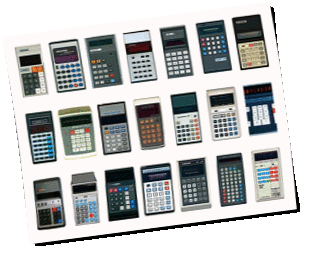 Orion Electronic Calculator
 Palson CX-3000 Tele Computer
Clon español del Interton VC 4000 ver más
Clon español del Interton VC 4000
 Parker ROM The Space Knight
 Polycon C4016
 Prinztronic Tournament Ten
 Promax uInstructor MI-650B
 Radio Shack Electronic Pocket Repeat
Radio Shack Pocket Repeat
 Radofin 10 Realistic Sports Action
Acetronic Electronic TV Game ver más
Acetronic Electronic TV Game
 Rollet Video Secam System 4-303
Rollet Video Secam System SD-050S ?? ver más
Rollet Video Secam System SD-050S ??
 Rowtron Television Computer System
 Sears 2 Player Baseball
Fonas Baseball (1979, LED, 9 Volt, Model# 2B-610) ver más
Fonas Baseball (1979, LED, 9 Volt, Model# 2B-610)
Sears 3 in 1 Sports
Entex Hockey (1979/80, LED, 3 AA Batteries, Model# 6006) ver más
Entex Hockey (1979/80, LED, 3 AA Batteries, Model# 6006)
Sears Baseball 2
Entex Baseball (1979 LED, 3 AA Batteries, Model# 8001) ver más
Entex Baseball (1979 LED, 3 AA Batteries, Model# 8001)
Sears Offense Defense Electronic Baseball
Entex Baseball 2 (1979, LED, 3 AA Batteries, Model# 6002) ver más
Entex Baseball 2 (1979, LED, 3 AA Batteries, Model# 6002)
Sears Team Play Basketball
Coleco Head to Head Basketball (1979, LED, 9 Volt, Model# 2150) ver más
Coleco Head to Head Basketball (1979, LED, 9 Volt, Model# 2150)
 Sharp Elsi Mate EL-8131
 Sharp MZ-80C
The Sharp MZ is a series of personal computers sold in Japan and Europe (particularly Germany and Great Britain) by Sharp beginning in 1978. ver más
The Sharp MZ is a series of personal computers sold in Japan and Europe (particularly Germany and Great Britain) by Sharp beginning in 1978.
Sharp MZ-80K
The Sharp MZ is a series of personal computers sold in Japan and Europe (particularly Germany and Great Britain) by Sharp beginning in 1978. ver más
The Sharp MZ is a series of personal computers sold in Japan and Europe (particularly Germany and Great Britain) by Sharp beginning in 1978.
 Shinsei Blastergame
 Sixplay
Soccer 2
 TRS-80 Model II
Tandy Electronic Repeat
Tandy Pocket Repeat
 Telemaster T-1000
empresa catalana Master Electronics S.A. ver más
empresa catalana Master Electronics S.A.
 Teleng Television Computer System
 Temco T800
Temco T800C
Temco T900
 Tiger Copy Cat
Tiger Copy Cat Jr
 Tomy Terra-Hit
 Unimex Mark X
Unimex PinBall
Unimex TV-10 Color
 Videomaster Colour Cartridge
Videomaster Database Games-Computer
Videomaster Grand Master
Variante de Videomaster Star Chess. ver más
Variante de Videomaster Star Chess.
Videomaster Star Chess
Videomaster Star Chess es una de esas auténticas rarezas tecnológicas, literalmente rara porque apenas se habla de ella, no porque sea dific… ver más
Videomaster Star Chess es una de esas auténticas rarezas tecnológicas, literalmente rara porque apenas se habla de ella, no porque sea dificil de encontrar o se haya convertido en sistema de culto. El catálogo de juegos de este sistema se reduce a 1: Star Chess.
 Voesa 3044
 Voltmace Database Games-Computer
 Wizard
Zilog Z8000
Zilog Z8000 is a family of 16-bit microprocessors introduced in 1979 between the Intel 8086 and the Motorola 68000. The series has been desi… ver más
Zilog Z8000 is a family of 16-bit microprocessors introduced in 1979 between the Intel 8086 and the Motorola 68000. The series has been designed by Masatoshi Shima and produced by Zilog and second sources AMD, SGS and Hitachi from 1979 until 1995. Since 1995, the CPU series continues to live and still is in production by Zilog in a pin-compatible CMOS release called the Z16C00 series (with the Z16C01 as the equivalent of Z8001 and the Z16C02 as the equivalent of Z8002). There are 4 slightly different Z8000 versions: Z8001: large memory version, can address up to 8 MB (divided into 128 segments up to 64 KB each) Z8002: small memory version, can address 64 KB Z8003: same as the Z8001 with added virtual memory support Z8004: same as the Z8002 with added virtual memory support The Z8000 series introduced a number of attractive new features from the mini-computer and mainframe worlds: Regular general-purpose register file (16 16-bit registers that could be used as accumulators, address registers, index registers or stackpointers) Separation of Normal and System modes (also known as User and Supervisor modes) for enhancing system integrity Large address space (8Mb) First commercial Memory management facility (Z8010 Z-MMU) Extended Processing Architecture (EPA) allowing co-processing in an efficient parallel fashion The Z8000 processor also had some drawbacks as compared to its close rival, the Motorola 68000: Segmented addressing: maximum segment size of 64Kb which complicates the addressing of very large data structures Delayed introduction due to tecnical problems Limited support (very limited software base, limited hardware support) Although initially the Z8000 got some acceptance and was widely recognised to have a very elegant and user-friendly architecture, it became quickly surpassed by the Motorola 68000 and the Intel 80286 in the commercial domain. In safe-critical environments however the processor apparently continued to play an important role.
 Zodiac
Visicalc
Aparece en el mercado la primera hoja de cálculo electrónica, la VisiCalc, de la mano de Software Arts ver más
Aparece en el mercado la primera hoja de cálculo electrónica, la VisiCalc, de la mano de Software Arts
 A-Man
A-Man
 Acorn Atom
El Acorn Atom era un ordenador comercializado por Acorn Computers Ltd entre 1980 y 1982. Basado en una mejora de la tecnología MOS 6502, er… ver más
El Acorn Atom era un ordenador comercializado por Acorn Computers Ltd entre 1980 y 1982. Basado en una mejora de la tecnología MOS 6502, era una versión recortada del Acorn System 3, sin unidad de disco y con teclado e interface para cassette. En 19880 se podía encontrar en kit (£120), totalmente montado (£170) o en formato versión expandida (£200), von 12KB de RAM y la extensión de punto flotante en la ROM.
 Alien
Alien
Alien Attack
Amaze-A-Tron
Otra maquinita diseñada por Ralph Baer. Las piezas de juego (25 numeradas) se guardan en un compartimento de la propia máquina. Como base ut… ver más
Otra maquinita diseñada por Ralph Baer. Las piezas de juego (25 numeradas) se guardan en un compartimento de la propia máquina. Como base utiliza el microprocesador TI TMS-100. De forma aleatoria, la máquina define una ruta que hay que seguir, informando mediante led de la primera y última pieza colocadas.
Apple III
El Apple III (frecuentemente escrito como Apple III) fue un ordenador personal diseñado, fabricado y comercializado por Apple Computer. Fue … ver más
El Apple III (frecuentemente escrito como Apple III) fue un ordenador personal diseñado, fabricado y comercializado por Apple Computer. Fue lanzado en mayo de 1980 y descatalogado el 24 de abril de 1984, tras devenir en el primer gran fracaso comercial de Apple. Su predecesor, el célebre Apple II, fue diseñado por Steve Wozniak co-fundador de Apple. Creado como un equipo para el mercado de negocios empresariales, el equipo que diseñó el Apple III comenzó a trabajar a finales de 1978 bajo la dirección del Dr. Wendell Sander. Tuvo como nombre en código Sara, el nombre de la hija de Sander.
 Aureac Mini 300
Aureac Video Play
Consola distribuida por Alreac, clon de la familia Interton VC-4000 Similar a la Palson CX-3000 ver más
Consola distribuida por Alreac, clon de la familia Interton VC-4000 Similar a la Palson CX-3000
 Autorennen
Champion Racer - Pilote de Course - Autorennen ver más
Champion Racer - Pilote de Course - Autorennen
 Basketball
Battle Beam
Bear And Salmon
 Bolidos Congost
Versión española Luis Congost S.A ver más
Versión española Luis Congost S.A
Bowlatronic
Bowling
 Cabel Universal Game Computer
Al igual que otras consolas de la familia Interton, los juegos son compatibles a nivel software, pero el formato de los cartuchos los hace i… ver más
Al igual que otras consolas de la familia Interton, los juegos son compatibles a nivel software, pero el formato de los cartuchos los hace incompatibles entre modelos. Curiosamente, los mandos solo tienen un botón, en lugar de los 14 típicos de la familia Interton Al menos se comercializaron 24 juegos para esta consola italiana: 1.Olympia 2.Auto-race 3.Tank-Battle 4.Black-Jack 5.Archimede 6.Pitagora 7.Arianna 8.Midway 9.Derby 10.Star-War 11.Boxing 12.Tivoli 13.Master-Mind 14.Tic-Tac-Toe 15.Safari 16.Musica 17.Twist 18.Othello 19.Flipper 20.Scacchi 21.Golf 22.Dama 23.Back Gammon 24.Soccer
Champion Racer - Pilote de Course - Autorenne
Coleco Quiz Wiz
Commodore PET 4000
La serie PET 4000 fue la versión final de lo que podría ser llamado como el PET clásico. Éste fue esencialmente el último modelo de la serie… ver más
La serie PET 4000 fue la versión final de lo que podría ser llamado como el PET clásico. Éste fue esencialmente el último modelo de la serie 2000, pero con un monitor más grande con imagen en verde y negro y una nueva versión del lenguaje de programación Commodore BASIC. PET 4000 Series: PET 4008 PET 4016 PET 4016 FAT-40 PET 4032 PET 4032 FAT-40
 Commodore VC20
Commodore VIC 1001
Commodore VIC 20
El Commodore VIC-20 (Commodore VC20 en Alemania, VIC-1001 en Japón) fue un ordenador doméstico de 8 bits fabricado y diseñado por Commodore … ver más
El Commodore VIC-20 (Commodore VC20 en Alemania, VIC-1001 en Japón) fue un ordenador doméstico de 8 bits fabricado y diseñado por Commodore Business Machines con 5 KB de RAM y una CPU MOS 6502. Tenía una forma similar al Commodore 64 y el C16, que fueron comercializados posteriormente. El VIC-20 fue lanzado en junio de 1980, cerca de 3 años después del primer computador personal de Commodore, el PET. El nombre VIC viene del chip de video (Video Interface Chip), que a pesar de su designación, también manejó toda la síntesis de sonido en el VIC-20.
Computer Chess
 Conic Multisport
Crazy Kong
 Cue Ball
 Cylon 16
También conocido como Sicom 16 , este es un sistema con 16 juegos en 1. ver más
También conocido como Sicom 16 , este es un sistema con 16 juegos en 1.
 Depraz Swiss Mouse
 Dick Smith System 80
Dick Smith Electronics in Australia brought out a re-badged version of the Video Genie called the System 80. ver más
Dick Smith Electronics in Australia brought out a re-badged version of the Video Genie called the System 80.
 Diset Computer Electro 1001
versión española de Coleco Quiz Wiz Existe una versión holandesa: Jumpo Computer Electro 1001 ver más
versión española de Coleco Quiz Wiz Existe una versión holandesa: Jumpo Computer Electro 1001
Draculajoh
 Dragon Castle
 EACA Video Genie EG-3003
Dick Smith Electronics in Australia brought out a re-badged version of the Video Genie called the System 80. These were identical except of … ver más
Dick Smith Electronics in Australia brought out a re-badged version of the Video Genie called the System 80. These were identical except of course they carried the Dick Smith Logo. I presume that that came from the same Eaca factory in Hong Kong. They also sold a business version with the keyboard, two floppy disk drives and expansion box with a clunky little printer.
Electronic Learning Machine
 Entex Mac Mini Computer
So, what the heck is it? From Jeff Adventurevisions correspondence with the owner of Entex (with an interesting digression): MAC Was a comp… ver más
So, what the heck is it? From Jeff Adventurevisions correspondence with the owner of Entex (with an interesting digression): MAC Was a computor for children intoduced before MS DOS . Entex made the first MSDOS computor called Envision before IBM but had to remove it from the market as the gurus predicted PCs had no future. This would have been true if the phone cos had been on the ball with an advanced web. and the ability to cope with the demand ,which is not yet the case. This is a very long story. We tried to create a Lan. in 1972 but the phone lines could not handle the transmission in many states. Very best wishes, (Entex guy) Actually, that seems to have little to do with the MAC Im talking about- the goofy red toy. The programs were on little cards (I guess) and there were no cartridges. Its native recognizable modes include annoying and obnoxious. Seriously they include Piano and Organ. I havent tried very hard to figure out what the other programs are, but Im sure they involve the mode button, as there seems to be no provision for storage/cartridges. MAC Computer pic#1 MAC Computer pic#2 MAC Computer screen shot The screen has both led lights (a 4x4 matrix) and LED calculator type display.
 Entex-Mac
So, what the heck is it? From Jeff Adventurevisions correspondence with the owner of Entex (with an interesting digression): MAC Was a comp… ver más
So, what the heck is it? From Jeff Adventurevisions correspondence with the owner of Entex (with an interesting digression): MAC Was a computor for children intoduced before MS DOS . Entex made the first MSDOS computor called Envision before IBM but had to remove it from the market as the gurus predicted PCs had no future. This would have been true if the phone cos had been on the ball with an advanced web. and the ability to cope with the demand ,which is not yet the case. This is a very long story. We tried to create a Lan. in 1972 but the phone lines could not handle the transmission in many states. Very best wishes, (Entex guy) Actually, that seems to have little to do with the MAC Im talking about- the goofy red toy. The programs were on little cards (I guess) and there were no cartridges. Its native recognizable modes include annoying and obnoxious. Seriously they include Piano and Organ. I havent tried very hard to figure out what the other programs are, but Im sure they involve the mode button, as there seems to be no provision for storage/cartridges. MAC Computer pic#1 MAC Computer pic#2 MAC Computer screen shot The screen has both led lights (a 4x4 matrix) and LED calculator type display.
 Epoch Mogura Punch
Epoch Tv Vader
Epoch TV-Vader incluye cuatro juegos inspirados en Space-Invaders Estos juegos aparecieron como cartucho en la Epoch Cassette Vision. ver más
Epoch TV-Vader incluye cuatro juegos inspirados en Space-Invaders Estos juegos aparecieron como cartucho en la Epoch Cassette Vision.
Fabuloso Fred II
 Fabulous Fred
 Fidelity Electronics Chess Challenger Sensory
 Flight Time
Football
 Gakken SuperPuck Monster
 Galoob-Handheld
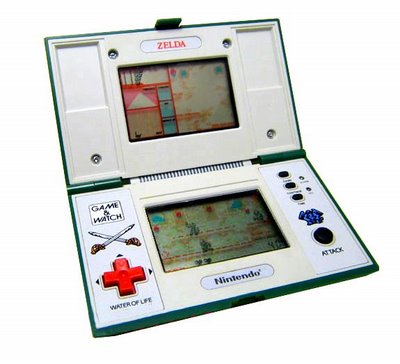
GameWatch
En abril de 1980 aparece la primera video-consola portátil de Nintendo, que se podía llevar en el bolsillo para jugar en cualquier sitio, in… ver más
En abril de 1980 aparece la primera video-consola portátil de Nintendo, que se podía llevar en el bolsillo para jugar en cualquier sitio, incluían una pantallita LCD y un juego fijo muy simple. Llegaron a aparecer unos 60 juegos distintos durante toda la década de los 80, que luego serían muy codiciados por los coleccionistas, entre ellos se contaban Donkey Kong y sus secuelas, nada menos que Super Mario Bros. Veinte años después se han puesto en el mercado versiones baratas de alguna de aquellas maravillas. Entre 1980 y 1987 fueron evolucionando en formas y colores, y casi siempre eran modelos muy atractivos y originales
General Instruments AY-3-8610
The AY-3-8610 was a major update from General Instruments. It played more games (10), like basketball or hockey, with higher-quality graphic… ver más
The AY-3-8610 was a major update from General Instruments. It played more games (10), like basketball or hockey, with higher-quality graphics. It was nicknamed Superstar by GI. It was in black and white, although it was possible to add color by using an additional AY-3-8615 chip. Prior to producing the 8610, GI created the AY-3-8600. The pin configuration was the same as the 8610, but it was missing the two rifle/target games, bringing the total number of games down to 8.
 Goleador Zapp
 Graphics Cards
A graphics card (also called a video card, display card, graphics adapter, VGA card/VGA, video adapter, display adapter, or colloquially GPU… ver más
A graphics card (also called a video card, display card, graphics adapter, VGA card/VGA, video adapter, display adapter, or colloquially GPU) is a computer expansion card that generates a feed of graphics output to a display device such as a monitor. Graphics cards are sometimes called discrete or dedicated graphics cards to emphasize their distinction to integrated graphics processor on the motherboard or the CPU. A graphics processing unit (GPU) that performs the necessary computations is the main component in a graphics card, but the acronym GPU is sometimes also used to refer to the graphics card as a whole.
Gravity
 Grundy New Brain A
El NewBrain A es una versión económica sin pantalla, vendida por menos de £30 ver más
El NewBrain A es una versión económica sin pantalla, vendida por menos de £30
Grundy New Brain AD
En 1978, tras el éxito obtenido el año anterior con el kit MK-14, Sinclair Radionics comienza a trabajar en un micro económico orientado al … ver más
En 1978, tras el éxito obtenido el año anterior con el kit MK-14, Sinclair Radionics comienza a trabajar en un micro económico orientado al mercado doméstico. Pero, cuando se hace evidente que el objetivo de un precio por debajo de las 100 libras no podrá alcanzarse con el nuevo ordenador, la compañía se centra en la producción de un equipo más asequible (el Sinclair ZX80). La administración británica, propietaria por ese entonces del 73% de las acciones de Radionics, decide que la empresa Newbury Labs continue trabajando sobre los diseños existentes. Inicialmente la BBC se interesó por el ordenador para un programa televisivo de alfabetización informática que estaba preparando, pero la producción en Newbury Labs se retrasa demasiado y sería el Acorn Proton el elegido para convertirse en el BBC Micro. Perdida la oportunidad de que la televisión pública popularizase el sistema, Newbury Labs se enfrenta con serios problemas financieros y la compañía Grundy adquiere el proyecto. Finalmente, tras cuatro años de vicisitudes, el Grundy NewBrain se pone a la venta. El Newbrain cuenta con algunas características poco habituales en los micros de su clase. Por ejemplo incluye dos interfaces de cassette que pueden utilizarse simultaneamente, dos interfaces serie, soporta resoluciones gráficas bastante elevadas y dispone de un completo juego de 512 caracteres. Sin embargo carece de sonido, los gráficos son monócromos, y la memoria RAM con la que se entrega de serie resulta escasa para aprovechar todo su potencial. El modelo AD incluye una pantalla con un alinea de 16 caractéres fluorescentes que permite usarlo sin necesidad de monitor. No tiene botón de reset ni ON/OFF. Internamente además es bastante complejo, pues buena parte de las funciones son realizadas mediante lógica discreta, y eso encarecía mucho el equipo. En cuanto a las posibilidades de expansión existe un módulo que proporciona nuevas salidas serie, salidas paralelo, puertos de joystick, y slots para software en ROM y ampliaciones de RAM de hasta 2MB. Se anunciaron también otros periféricos, aunque su disponibilidad fue bastante limitada: una controladora de discos con soporte para CP/M, módulos de memoria para conectar al expansor mencionado (de 64, 128, 256 y 512KB), un módulo de baterías, un módulo de videotext y un módulo con múltiples interfaces V24 para conectar varios ordenadores entre si. Las prestaciones y el precio del micro lo hacían poco atractivo para el mercado doméstico, y además apenas se comercializó software de entretenimiento. Aunque sí alcanzó una limitada difusión, por ejemplo en el sistema educativo holandés o para aplicaciones de gestión, el sistema resultó un fracaso comercial. Actualmente el hecho de que no sea un ordenador demasiado común, y posiblemente su relación con la compañía Sinclair, hacen del NewBrain una pieza bastante valorada por los coleccionistas.
Grundy New Brain M
El modelo M, de móvil, además de la pantalla incluía unas baterías que le proporcionan cierta autonomía. ver más
El modelo M, de móvil, además de la pantalla incluía unas baterías que le proporcionan cierta autonomía.
H2H Baseball
H2H Basketball
H2H Boxing
H2H Football
H2H Hockey
H2H Soccer
 Hasbro Mini Simon
Hasbro Mini Simon Trickster
Hasbro Miniature Simon
Hasbro Simon Flash
 Hitachi MB6881
 Hockey
 I Took A Lickin From A Chicken
 Intertec Superbrain
Kingsford Mini Match Me
 Kosmos Computer-Praxis CP1
Microprocesador de aprendizaje. ver más
Microprocesador de aprendizaje.
 LSI Defender
Lambda System - Victor Lambda
La primera versión de Vicor Lambda, comercializada por Lambda System y basada en un Intel 8080A, no tuvo muchas ventas y es dificil de encon… ver más
La primera versión de Vicor Lambda, comercializada por Lambda System y basada en un Intel 8080A, no tuvo muchas ventas y es dificil de encontrar. Los modelos posteriores, basados en Z80A y rediseñados por Micronique son más comunes.
 Live Action Football
Look Alive Baseball
Look Alive Basketball
No llego a comercializarse ver más
No llego a comercializarse
Look Alive Football
Mancala
 Mattel Intellivision
La Intellivision fue desarrollada por Mattel Electronics, una subsidiaria formada expresamente para el desarrollo de juegos electrónicos. La… ver más
La Intellivision fue desarrollada por Mattel Electronics, una subsidiaria formada expresamente para el desarrollo de juegos electrónicos. La consola fue probada en Fresno, California, en 1979 con un total de cuatro juegos disponibles, y se lanzó en todo Estados Unidos en 1980 con un coste de 299 dólares y un juego de regalo: Las Vegas Poker Blackjack. A pesar de no ser el primer sistema que se enfrentó a Atari (sistemas hechos por Fairchild Semiconductor, Bally, y Magnavox ya estaban en el mercado), fue la primera consola que significó una seria amenaza al dominio de Atari. Una serie de publicidades presentadas por el periodista George Plimpton fue producida, en donde Plimpton defenestraba las menores capacidades del Atari 2600 comparando ambas consolas con juegos del mismo género. Uno de los eslogan utilizados en las diferentes publicidades señalaban al Intellivision como lo más cercano a la vida real; un ejemplo es un aviso comparando juegos de golf - mientras los otros tenían gráficos sencillos y sonidos monótonos, el Intellivision presentaba sonidos realísticos y gráficos de mayor resolución (aunque indudablemente crudos comparados con consolas modernas). Al igual que Atari, Mattel licenció su consola a otras empresas para que la vendan bajo su propia marca. Estos modelos incluyen el Tandyvision de Radio Shack, el Intellivision de GTE-Sylvania, y el Super Video Arcade de Sears. (El modelo de Sears fue un golpe para Mattel, ya que esta empresa ya vendía una versión del Atari 2600, haciendo una gran contribución a la popularidad de Atari.) En ese primer año Mattel vendió 175.000 consolas Intellivision, y la librería de juegos creció hasta alcanzar los 19 juegos. Hasta este punto, todos los juegos estaban producidos por una compañía llamada APh. Mattel se dio cuenta que lo que hasta ahora habían visto como un producto secundario se convirtió en un gran éxito. Entonces, Mattel decidió abrir su propio equipo de desarrollo de software para el Intellivision. Los cinco miembros originales de equipo del Intellivision fueron el director Gabriel Baum, Don Daglow, Rick Levine, Mike Minkoff y John Sohl. Levine y Minkoff (unos veteranos de la línea de juguetes de Mattel) llegaron desde el equipo de producción de juegos de mano de Mattel. Para evitar que los programadores fueran contratados por el rival Atari, su identidad y lugar de trabajo fue guardada en secreto. En público, los programadores eran conocidos colectivamente como los Blue Sky Rangers. Para 1982 las ventas se habían disparado. Más de dos millones de Intellivision habían sido vendidas para el final de ese año, dándole a Mattel una ganancia de 100 millones de dólares. Las compañías Activision e Imagic empezaron a lanzar títulos para la consola, al igual que sus rivales, y Atari y Coleco lanzaron nuevos productos para poder competir con Mattel: el Atari 5200 y el Colecovision, respectivamente. Mattel creó juegos bajo la marca M Network para los sistemas de Atari y Coleco. Los títulos más populares vendieron más de un millón de copias. El Intellivision también fue vendido en Japón de la mano de Bandai. El equipo de desarrollo de videojuegos de Mattel había crecido, y de tan sólo 5 personas había pasado a tener 110 empleados bajo el ahora vice presidente Baum.
Micronique Victor Lambda
La empresa francesa Micronique (componentes electrónicos) adquirió, en 1981, los derechos del ordenador Family Computer modelo I (USA, 1979)… ver más
La empresa francesa Micronique (componentes electrónicos) adquirió, en 1981, los derechos del ordenador Family Computer modelo I (USA, 1979) comercializado en los Estados Unidos por la empresa norteamericana Interact y en Francia por Lambda System (que fue a la bancarota solo un poco despues de Interact). En 1982, lanzó al mercado su propio ordenador, basado en el modelo americano (teclado qwerty, procesador i8080, 16K de RAM y 2K de ROM sin BASIC), con el nombre de Victor Lambda. El Victor Lambda tuvo cuatro versiones: Primera versión: con teclado de goma y color negro, se diferenciaba del Interact por disponer de conector RGB (euro conector) en lugar de salida HF a la TV. Las letras están escritas en la carcasa, encima de la tecla correspondiente. Segunda versión: con el mismo teclado de goma y carcasa de color blanco, Tercera versión: el teclado pasa a ser mecánico. Los caracteres de las letras están ahora escritas en la parte superior de la tecla. Cuarta versión: se diferencia del anterior por el logo
 Milton
Milton Plus One
Netronics Elf II
The Netronics ELF II was an early microcomputer trainer kit featuring the RCA 1802 microprocessor, 256 bytes of RAM, DMA-based bitmap graphi… ver más
The Netronics ELF II was an early microcomputer trainer kit featuring the RCA 1802 microprocessor, 256 bytes of RAM, DMA-based bitmap graphics, hexadecimal keypad, two digit hexadecimal LED display, a single Q LED, and 5 expansion slots. The system was developed and sold by Netronics Research and Development Limited in New Milford, CT, USA.
 Nikko Mini Vader
Nintendo Computer TV Game
En 1980 el Computer TV Game o Computer Othello y a continuación las GameWatch. コンピュータ TV ゲーム ver más
En 1980 el Computer TV Game o Computer Othello y a continuación las GameWatch. コンピュータ TV ゲーム
 Nintendo GameWatch Fire
 Nordmende Color Teleplay
Se adapta a algunos modelos de televisores Nordmende ver más
Se adapta a algunos modelos de televisores Nordmende
Nordmende Color Teleplay uP
alemana o italiana? ver más
alemana o italiana?
Pac-Man
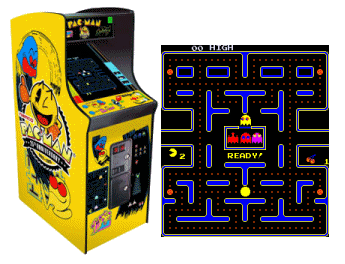
Diseñado por Tor Iwatani para Namco, se basaba en un antiguo cuento popular japonés, y fué conocido en el mundo latino como Comecocos y con … ver más
Diseñado por Tor Iwatani para Namco, se basaba en un antiguo cuento popular japonés, y fué conocido en el mundo latino como Comecocos y con otros nombres locales. Su popularidad fué tal que se convirtió en icono de los años 80 y de los propios videojuegos. Aumentó el mercado de los videojuegos, para millones de personas este fué el primer videojuego que se cruzó en su vida. Con innumerables versiones, la idea de Pac-man es simple, se trata de comer puntos y frutas en un laberinto a la vez que se evitan los archifamosos fantasmas que intentan atraparte. Historia del videojuego en estado puro
 Philips P2000
The Philips P2000T home computer was Philips first real entry in the home computer market, after the Philips Videopac G7000 game system (bet… ver más
The Philips P2000T home computer was Philips first real entry in the home computer market, after the Philips Videopac G7000 game system (better known in the U.S. as the Magnavox Odyssey2) which they already sold to compete with the Atari 2600 and similar game systems. There was also an P2000M version with an additional 80-column card for use with a monochrome monitor. This version shipped with a monitor cabinet also housing a dual 5.25 floppy drive.[1] The P2000T was a Z80-based home computer that used a Teletext display chip to produce the video picture and a small Mini-Cassette recorder for 42 kilobytes of mass storage capacity.[1] The Mini-Cassette was treated as a floppy drive from the users perspective while using the automatic search for a program (CLOAD command) or free space (CSAVE). A command to display the directory of the cassette also exists.[1] Philips used components they already produced for other markets (television sets and dictation machines) to quickly design a small computer system. It was partially designed by Austrian professor Dieter Hammer. They also copied the ROM cartridge system from their Videopac G7000 game system. One of these cartridges contained Microsoft BASIC. It was also possible to use cassette tape floppies. Although the Teletext video chip permitted a quick entry into the home computer market, it was also the major weakness of the P2000T. Using the Teletext standard in itself was not a bad idea because it did support eight colors and rudimentary graphics. But unlike later entries in the home computer market which also supported a Teletext display mode, such as the venerable BBC computer and the Oric Atmos, the P2000T did not support a high resolution display mode. This made it very difficult to develop interesting games for it. As a result, the P2000T had only limited success, and Philips later replaced it with their MSX machines. The machine did gain popularity in The Netherlands, especially in the areas of science, education, and data communications (videotex). The P2000M incorporated two 5,25-inch floppy disk drives beside a built-in monochrome screen. It could run CP/M or Microsoft BASIC applications, depending on the cartridge used. It was incompatible with the P2000T in the way it handled display of special characters (color, graphics mode), which made most P2000T games unplayable. Initially, in 1981, the computer cost 3000 guilders (1361). In 1984 the price was lowered to 1200 guilders (544,50).[2][3] The P2000 system can be emulated with the MESS software.[1]
Pinball
Playcable
PlayCable was an online service introduced in 1980 that allowed local cable television system operators to send games for the Intellivision … ver más
PlayCable was an online service introduced in 1980 that allowed local cable television system operators to send games for the Intellivision over cable wires alongside normal television signals. Through the service, subscribers would use a device, called the PlayCable adapter, to download the games for play on their Intellivision. PlayCable was not widely adopted, due in part to high costs for users and operators, as well as limitations of the PlayCable adapter. The service was discontinued in 1983.
 Pro Action Baseball
Pro Action Soccer
 Quelle Spiel Computer
Race Thru Space
Sears 7 in 1 Sports
Tiger 7-in-1 Sports Stadium (19xx, LED, 9 Volt, Model# 7-555) ver más
Tiger 7-in-1 Sports Stadium (19xx, LED, 9 Volt, Model# 7-555)
Sears Baseball
Bandai Baseball (1978, LED, 9 Volt, Model# 7931) ver más
Bandai Baseball (1978, LED, 9 Volt, Model# 7931)
Sears Blast It
Entex Blast It (1980, LED, 6 AA batteries, Model# 6015) ver más
Entex Blast It (1980, LED, 6 AA batteries, Model# 6015)
Sears Computron
Sears Cosmic Pinball
Tiger Rocket Pinball (1979, LED, 4 AA Batteries, Model# 7-460) ver más
Tiger Rocket Pinball (1979, LED, 4 AA Batteries, Model# 7-460)
Sears Electronic Baseball
Entex Baseball (1979 LED, 3 AA Batteries, Model# 8001) ver más
Entex Baseball (1979 LED, 3 AA Batteries, Model# 8001)
Sears Electronic Basketball
Tiger Half Court Basketball (1979, LED, 4 AA Batteries, Model# 7-470) ver más
Tiger Half Court Basketball (1979, LED, 4 AA Batteries, Model# 7-470)
Sears Electronic Numbers Game
Tiger Think Tank (19??, LED, 9 Volt, Model# 7-440) ver más
Tiger Think Tank (19??, LED, 9 Volt, Model# 7-440)
Sears Electronic Soccer
Entex Soccer (1979, LED, 3 AA Batteries, Model# 6003) ver más
Entex Soccer (1979, LED, 3 AA Batteries, Model# 6003)
Sears Electronic Touchdown
Coleco Electronic Quarterback (1978, LED, 9 Volt, Model# 2020) ver más
Coleco Electronic Quarterback (1978, LED, 9 Volt, Model# 2020)
Sears Follow Me
Tiger Copycat (1979-88, LED, 9 Volt, Model# 7-520/522) ver más
Tiger Copycat (1979-88, LED, 9 Volt, Model# 7-520/522)
Sears Hockey
Bandai Hockey (19xx, LED, 9 Volt, Model# 907933) ver más
Bandai Hockey (19xx, LED, 9 Volt, Model# 907933)
Sears Offense Defense Electronic Basketball
Entex Basketball 2 (1980, LED, 3 AA batteries, Model# 6010) ver más
Entex Basketball 2 (1980, LED, 3 AA batteries, Model# 6010)
Sears Offense Defense Electronic Football
Entex Football 3 (1980, LED, 3 AA Batteries, Model# 6018) ver más
Entex Football 3 (1980, LED, 3 AA Batteries, Model# 6018)
Sears Talking Computron
Sears Team Play Football
Coleco Head to Head Footall (1980, LED, 9 Volt, Model# 2140) ver más
Coleco Head to Head Footall (1980, LED, 9 Volt, Model# 2140)
Sears Team Play Hockey
Coleco Head to Head Hockey (1980, LED, 9 Volt, Model# 2160) ver más
Coleco Head to Head Hockey (1980, LED, 9 Volt, Model# 2160)
Sears Team Play Soccer
Coleco Head to Head Soccer (1980, LED, 9 Volt, Model# 2170) ver más
Coleco Head to Head Soccer (1980, LED, 9 Volt, Model# 2170)
 Sears Video Arcade B
Clon de la Atari VCS CX2600A comercializada por Sears. ver más
Clon de la Atari VCS CX2600A comercializada por Sears.
Sharp Elsi Mate EL-215
 Sharp PC-1210
Sharp PC-3101
Sharp PC-3201
 Sharp Pocket Computer PC-1211
clon del TRS-80 Pocket Computer PC-1 ver más
clon del TRS-80 Pocket Computer PC-1
Sicom 16
Simon Pocket
 Sinclair ZX80
Soccer
Space Blaster
Space Chaser
Split Second
Another challenge game with several built-in games. ver más
Another challenge game with several built-in games.
Star Trek - The Electronic Game
Strategy Baseball
Super Simon
TRQ Tele-Juego Color-10
TRS-80 Color Computer
El TRS-80 Color Computer (Coco) fue comercializado por Tandy en 1980. Usaba un procesador Motorola 6809 a 0.89 MHz. Venía con 4 KiB RAM y se… ver más
El TRS-80 Color Computer (Coco) fue comercializado por Tandy en 1980. Usaba un procesador Motorola 6809 a 0.89 MHz. Venía con 4 KiB RAM y se podía expandir hasta 32 KiB de RAM. Usaba una versión de BASIC escrita por Microsoft llamada Tandy Color BASIC que ocupaba 8 KiB ROM. La salida de video era a través de la pantalla de televisión, en donde se desplagaban 16 líneas de 32 caracteres de texto (32 x 16) solo en mayúsculas (las minúsculas se representaban con los mismos caracteres en mayúsculas pero con video inverso) y gráficos hasta una resolución de 192 líneas con 256 píxels por línea (256 x 192). Tenía un teclado con teclas tipo chiclets, llamado de esta manera porque, a diferencia de un teclado normal, las teclas eran pequeños rectángulos que parecían Chiclets con cobertura dulce, similares a las teclas de una calculadora.
TRS-80 Model III
TRS-80 Pocket Computer PC-1
Telemaster T-1200
empresa catalana Master Electronics S.A. ver más
empresa catalana Master Electronics S.A.
Tomy Black Rider
Tomy Digital Daredevil / Eddie Kidds Stunt Bike / Moto Cross / Black Rider ver más
Tomy Digital Daredevil / Eddie Kidds Stunt Bike / Moto Cross / Black Rider
Tomy Moto Cross Meccatronic
Tomy Digital Daredevil / Eddie Kidds Stunt Bike / Moto Cross / Black Rider ver más
Tomy Digital Daredevil / Eddie Kidds Stunt Bike / Moto Cross / Black Rider
Torpedo Shoot
Torpedo Shoot - Mr Subattack - Bataille Sous-
Torpedo Shoot - Mr. Subattack - Bataille Sous
Total Control 4
 VHS Video Games
VHSVideo Games
Vampire
Vampire - Dracula ver más
Vampire - Dracula
 Videoton TV Computer 64
Videoton TVComputer
 Watch Game 10
Witty
World Championship Baseball
World Championship Football
 Xerox 860
Zap
3-D Escape 1000 Mazes
3-D Grand Prix
AMD 8086
 Acetronic Tele-Sports IV
 Acorn BBC Micro
El BBC Microcomputer System, o BBC Micro, eran una serie de ordenadores y periféricos diseñados y fabricados por Acorn para el proyecto de l… ver más
El BBC Microcomputer System, o BBC Micro, eran una serie de ordenadores y periféricos diseñados y fabricados por Acorn para el proyecto de la BBC(British Broadcasting Corporation) Computer Literacy Se produjeron nueve modelos bajo el sello BBC,refiriéndose a los seis primeros modelos (Model A, B, B64, B128, Master 128, and Master Compact) con el nombre genérico BBC Micro, mientras que los demás modelos se llamaban comunmente Acorns Archimedes.
 ActionGT Black Belt
Air Traffic Control
 Alien invaders
 Ameprod TVG-10
La TVG-10 es una consola de videojuegos de origen polaco, producido por Mera-Elwro entre los 70 y los 80 del siglo XX. En 1983, la producció… ver más
La TVG-10 es una consola de videojuegos de origen polaco, producido por Mera-Elwro entre los 70 y los 80 del siglo XX. En 1983, la producción de la TVG-10 fue transferido a la empresa privada Ameprod. Era la única consola producido en Polonia. La consola, que le permite reproducir juegos como el tenis, paddle y tiene dos juegos de seis. Los juegos pueden ser adaptados a la habilidad del jugador (velocidad de movimiento de la pelota, el tamaño de la bola, etc.). Además, se puede jugar a dos juegos que implican el uso de una pistola óptica. Los gráficos y de la lista de juegos se puede suponer que la consola se basa en cualquiera de chip AY-3 - ???? de General Instrument. Lista de juegos incorporados en la TVG-10: tenis hockey calabacín pelota vasca golpear un blanco en movimiento pistola de luz juego
 Amidar
Arcade Defender
Bakudan Man
Bakudan Man - Knaller-Ede - Dynamite
 Bambino Safari
Página 8 de 22