Timeline
La historia completa: lanzamientos, quiebras, inventos y momentos clave de la industria, década a década.
Mostrando eventos 1001–1250 de 5387.
 Quatro TV Sport DX-503
 Quelle Universum TV Multi-Spiel
 RCA Studio II
La RCA Studio II es una consola creada por RCA que apareció en enero de 1977. Los gráficos son en blanco y negro, muy similares a las numero… ver más
La RCA Studio II es una consola creada por RCA que apareció en enero de 1977. Los gráficos son en blanco y negro, muy similares a las numerosas variantes del pong disponibles en esa época. En lugar de joystick o pads, utiliza dos teclados de 10 teclas que no se separan de la propia base de la consola, lo que dificulta el juego simultaneo de dos jugadores. Puede generar simples sonidos con alguna varición en el tono y duración. Algo que la distingue es que incluye cinco juegos embebidos, además la alimentación y la señal de antena se combinan en una misma caja. Este sistema no se utilizó hasta la Atari 5200. Otra diferencia con el resto de las consolas de cartuchos en la que los cartuchos se insertan en la consola, en la RCA podríamos decir que es la consola la que se inserta en los juegos. Esta consola no tuvo mucho éxito, la Fairchild Channel F, que apareció un tiempo antes, la dejó obsoleta antes de su lanzamiento. Para colmo, solo 10 meses salió la Atari 2600, muy superior a estas dos máquinas. Como hubo un prototipo llamado RCA Studio, a la versión final la llamaron RCA Studio II. Muy lógico pero algo desconcertante para el comprador.
 RFT BSS 01 TV-Spiel
El BSS 01 (abreviatura de pantalla de juego 01, también RFT juego de la TV) es un asociado de la 1980-1984 combinar la microelectrónica Erfu… ver más
El BSS 01 (abreviatura de pantalla de juego 01, también RFT juego de la TV) es un asociado de la 1980-1984 combinar la microelectrónica Erfurt VEB fábrica de semiconductores de Frankfurt (Oder) en la consola de juegos RDA construido. Pero vinieron sólo muy rara vez en el hogar. El BSS 01 es la única consola de juegos fabricado en la RDA. The BSS 01 has been produced starting around 1980 in the former GDR by RFT. BSS does actually mean BildSchirmSpiel, and can be translated as Video Game. The console changed its colour more than once (probably because of material shortage), and is based upon the GI AY-3-8500-7 chip. While many won’t consider this as being important, this is in fact an interesting detail, because it was usual in the GDR to simply copy the silicon, or try to emulate its behaviour with discrete circuits. The main problem was - as with most electronic items - the price: it sold for about 500 East-German Marks. This was about half of the average wage, thus more than many could afford. This resulted in the fact that this unit was mostly used by educative institutions (e.g. Pionierhaus - House of Pioneers).
RFT BSS 01 TV-Spiel Kit
RFT BSS 01 TV-Spiel White
RFT TV Spiel black
 RTF BSS 01 TV-Spiel
El BSS 01 (abreviatura de pantalla de juego 01, también RFT juego de la TV) es un asociado de la 1980-1984 combinar la microelectrónica Erfu… ver más
El BSS 01 (abreviatura de pantalla de juego 01, también RFT juego de la TV) es un asociado de la 1980-1984 combinar la microelectrónica Erfurt VEB fábrica de semiconductores de Frankfurt (Oder) en la consola de juegos RDA construido. Pero vinieron sólo muy rara vez en el hogar. El BSS 01 es la única consola de juegos fabricado en la RDA. The BSS 01 has been produced starting around 1980 in the former GDR by RFT. BSS does actually mean BildSchirmSpiel, and can be translated as Video Game. The console changed its colour more than once (probably because of material shortage), and is based upon the GI AY-3-8500-7 chip. While many won’t consider this as being important, this is in fact an interesting detail, because it was usual in the GDR to simply copy the silicon, or try to emulate its behaviour with discrete circuits. The main problem was - as with most electronic items - the price: it sold for about 500 East-German Marks. This was about half of the average wage, thus more than many could afford. This resulted in the fact that this unit was mostly used by educative institutions (e.g. Pionierhaus - House of Pioneers).
RTF TV Spiel
RTF TV Spiel black
 Radio Shack TV Scoreboard - Model 60-3054
Radio Shack TV Scoreboard - Model 60-3055
Radio Shack TV Scoreboard - Model 60-3056
Radio Shack TV Scoreboard - Model 60-3057
Radio Shack TV Scoreboard - Model 60-3060
Dispone de conector para una gran pistola. Actualmente no dejarían pasar esta máquina por un aeropuerto. ver más
Dispone de conector para una gran pistola. Actualmente no dejarían pasar esta máquina por un aeropuerto.
Radio Shack TV Scoreboard - Model 60-3061
Dispone de conector para una gran pistola. Actualmente no dejarían pasar esta máquina por un aeropuerto. ver más
Dispone de conector para una gran pistola. Actualmente no dejarían pasar esta máquina por un aeropuerto.
Radio Shack TV Scoreboard - Model 60-8051
La caja tiene el texto en indlés y francés, y la máquina es igual al Radio Shack TV Scoreboard - Model 60-3051 Me atrevería a decir que esta… ver más
La caja tiene el texto en indlés y francés, y la máquina es igual al Radio Shack TV Scoreboard - Model 60-3051 Me atrevería a decir que esta variante fue comercializada en Canadá.
 Radiola Jeu Electronique Televise 4J
Radiola T-02
 Radofin 1392 Advanced Programmable Video Syst
Radofin Jeux Video 3011
Radofin Programmable Tele-Sports III
Radofin Sport-Action TV Game
Radofin TV Game
Radofin Tele-Sports
Radofin Tele-Sports Mini
Distribuido por Coleco ver más
Distribuido por Coleco
Radofin Tele-Sports Mini Black White
Radofin Tele-Sports black and white TV game
Radofin Tele-Sports colour TV game
 Reel Giochi TV 400
Reel Giochi TV 400 red
Reel Giochi TV 402
Reel Giochi TV 403 Color
Reel Giochi TV 412
Reel Giochi TV4 401
Reel Giochi TV4 401 Bianco Nero
Reel Giochi TV4 403 Color
Reel Giochi TV6 403
Reel Giochi TV6 403 Bianco Nero
 Regina Colour TV Game
Regina R-1800
Regina R-250
Regina T-338
Regina T-800
Regina TV Game AU-807
 Research Machines 380Z
 Ricochet Super Pro
Ricochet Super Pro MT-4A ver más
Ricochet Super Pro MT-4A
Ricochet Super Pro MT4A
Ricochet Super Pro MT-4A ver más
Ricochet Super Pro MT-4A
 Ridgewood Gamatic 7600
 Riva T-338
Riva T338
Riva T800
 Roberts Rally IV
Roberts Sportrama 8
Roberts Super Color Volley X
Roberts Video X
Roberts Volley VI
 Ronex Electronic TV Game Centre 15
Ronex TV-Spill
 SEB Telescore 750
At the end of the 70s, SEB, a well known french kitchen ustensils manufacturer, decided to sell its own pong system, just like the other com… ver más
At the end of the 70s, SEB, a well known french kitchen ustensils manufacturer, decided to sell its own pong system, just like the other companies. The design is very original with this particular black round shaped case and the flashy orange sliders and switches! The chipset is not the classic AY-3-8500 from General Instrument but the TMS-1965 from Texas-Instrument. It offers the same 4 basic games.
SEB Telescore 751
4 games available on 750 and 751 models: - Tennis - Football - Pelote basque - Squash The 752 model introduce the gun and 2 dedicated games… ver más
4 games available on 750 and 751 models: - Tennis - Football - Pelote basque - Squash The 752 model introduce the gun and 2 dedicated games : - Tir aux pigeons (birds shooting) - Tir dentraînement (Shoot training) A few other models followed this one, offering separated controllers and lightgun (model 751), and later even colour display (model 752) Modèle 750 avec la trappe en plastique fumé et 4 jeux. Modèle 751 avec les manettes de jeux séparées et 6 jeux. Les manettes séparées apparaîtront sur le modèle 751et le pistolet sur le modèle 752
SEB Telescore 752
 Samdo GM-402
Samdo GM-402 white
 Sands TV Game C-2200
Sands TV Game C-2200 new box
Sands TV Game C-2300
Sands TV Game C-2500
Sands TV Game C-3000
 Santron Home TV Game TG-101
Santron Home TV Game TG-201
Santron TG-101
 Sanwa 9009
Sanwa 9012
Sanwa 9015
 Scomark 4 Sports Tele
 Sears Cartridge Tele-Games System Video Arcad
La cadena Sears adquirió los derechos para comercializar la Atari 2600, y como solía hacer con otras máquinas, le cambiaba el empaquetado y … ver más
La cadena Sears adquirió los derechos para comercializar la Atari 2600, y como solía hacer con otras máquinas, le cambiaba el empaquetado y colocaba su propio logo. Esta es la versión de Atari VCS CX2600 heavy sixer.
 Sears Tele-Games Hockey-Jokari
Sears Tele-Games Hockey-Pong
Sears Tele-Games Hockey-Tennis
Sears Tele-Games Hockey-Tennis II
Sears Tele-Games Hockey-Tennis III
Sears Tele-Games Motocross Sports Center IV
Sears Tele-Games Pong Sports II
Sears Tele-Games Pong Sports IV
clon Atari Ultra Pong Doubles ver más
clon Atari Ultra Pong Doubles
 Sennheiser TV Game TVG-96
 Seville AU-807
Seville T-338
 Sharleen D5614
Sharleen TV Game T-338
 Sharp Elsi Mate EL-201
Sharp Elsi Mate EL-502
 Sharp KJS TV Game XG-102
Esta consola de hotal funciona con monedas. Utiliza varios chips de pong dedicados GI AY-3-8600-1 GI AY-3-8610-1 GI AY-3-8603-1 GI AY-3-8606… ver más
Esta consola de hotal funciona con monedas. Utiliza varios chips de pong dedicados GI AY-3-8600-1 GI AY-3-8610-1 GI AY-3-8603-1 GI AY-3-8606-1
Sharp SM-B-80TC
Sharp SM-B-80TE
Sharp TV Sport EP-800
 Sheen 4711 Most Exciting Tank Battle
Sheen Colour Video-Sport 106C
Sheen TVG-201
Sheen TVG-209
Sheen TVG-406-6
Sheen TVG-468-10
Sheen Video-Sport 100
Sheen Video-Sport 104
Sheen Video-Sport 106
 Siemens Bildmeister Turnier FZ2001
 Silcom Telegioco
Silcom Telegioco Color
 Silora Telegame 2001
 Sinclair Cambridge Calculator
 Skylark VideoSport 124
Fabricada por la empresa coreana Sunkyong Ltd, es fácil de encontrar en Austria y Alemania ver más
Fabricada por la empresa coreana Sunkyong Ltd, es fácil de encontrar en Austria y Alemania
 Smash-4
 Societe Occitane OC 5000
Societe Occitane OC 7000 Bataille Du Tanks
Societe Occitane OC4
 Solus TVG-100
 Sonesta Hide-away TV Game
Sonesta Hide-away TV Game Colour
 Sonico Color Video Game 406-6
 Sonix BTVG-JM888
Sonix CTVG-JM777
 Soundic TV Sports
Soundic TVG SD-01
Soundic TVG SD-01 azul
Soundic Video Computer Game MPT-03
Soundic Video Raceway
 Sovereign Coloursports
 Spinoball
 Sport King Model-105
 Sportel Paddle IV
Sportel Pong Soccer
Sportel TV Sport XY-4
 Sportron 101
Sportron 105
Sportron 106
Sportron 201
 Sportronic TVSport
States Toho Comet 8000
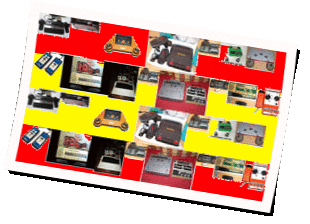 Sunitron Video Juegos Color
 Super Raf TVG-266
Super Raf TVG-621
 Superbowl XV Football
 Superlectron TV Challenger Series 3000
 Supersport 1 T-800C
Supersport 2 T-800
 Syrelec Videoshoot
Syrelec Videoshoot 2
 TCR Video Sport 600
TCR Video Sport 7701
 TEC - FS4
TEC FS-204
TEC FS-404
TRQ Tele-Juego BN-4
La compañía española Talleres Radioeléctricos Querol S.L. distribuyó a partir de 1978 este modelo de pong con altavoz interno, basado en el … ver más
La compañía española Talleres Radioeléctricos Querol S.L. distribuyó a partir de 1978 este modelo de pong con altavoz interno, basado en el chip General Instrument AY-3-8500 (1976). Aunque este chip permite configurar máquinas de 6 juegos, Tennis(pong)-Hockey-Squash-Practice-2RiffleShooting, en el TRQ se omitieron los dos que requieren pistola. Los iconos utilizados para el selector de juego fueron españolizados, quedando como Tenis (tennis), Futbol (hockey), Frontón 1 jugador (practice) y Frontón 2 jugadores (squash). Existe un séptimo juego no documentado (Handicap), que otorga ventaja al jugador de la derecha en el hockey, añadiéndola una paleta adicional. Para acceder a este juego en el TRQ, basta con colocar el selector de juego en la zona intermedia entre el futbol y el fronton. Aunque la salida del AY-3-8500 es en blanco y negro, el circuito adicional AY-3-8515 permite añadirle color. Funciona con una fuente externa de 9VDC (macho, negativo al centro) o con una pila de 9V. Hay un modelo azul y otro naranja, aunque puede que existan otras variantes. En el modelo naranja se incorporó un modulador de RF de Astec International (UM1167E3), lo que obligó a re-diseñar las pistas y eliminar el compartimento de la pila.
TRQ Tele-Juego Color-4
 TRS-80 Model I Level I
El TRS-80 (Tandy Radio Shack Z-80), también cariñosamente o burlonamente conocido como el Trash-80 (Basura-80), era la designación para vari… ver más
El TRS-80 (Tandy Radio Shack Z-80), también cariñosamente o burlonamente conocido como el Trash-80 (Basura-80), era la designación para varias líneas de sistemas de microcomputadores producidos por Tandy Corporation y vendidos a través de sus almacenes Radio Shack a finales de los 70 y en los 80. Anunciado en una rueda de prensa el 3 de agosto de 1977, el Tandy TRS-80 Modelo I fue el punto de entrada de Tandy Corporation en el mercado del computador casero, significando competir directamente contra el Commodore PET 2001 y el Apple II. Fue lanzado el 2 de febrero de 1977. Se vendía en $599 en la forma de un paquete que incluyó un monitor en blanco y negro de 12 pulgadas, grabador/reproductor de cassettes y la unidad central de procesamiento. Fue el producto más costoso que la cadena de tiendas de productos electrónicos de Tandy, Radio Shack, había ofrecido hasta entonces. La gerencia de la compañía estaba insegura de la atracción en el mercado que el computador podría tener y por ello mantuvo la producción inicial en sólo 3.000 unidades, de modo que si la computadora fallaba en venderse, pudiera por lo menos ser utilizada para propósitos de contabilidad dentro de los 3.000 almacenes de la cadena. Sin embargo, fue tal su éxito que Tandy terminó vendiendo 10.000 computadores el primer mes y 55.000 el primer año. Antes de descatalogarse en enero de 1981, se vendieron más de 250.000 unidades.
TUG
TV Mate Baron
 TV Spel AU-807
TV Spel T-338
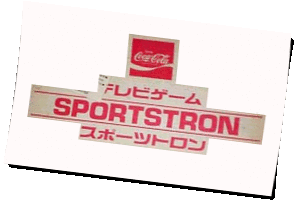 TV-Game Sportstron
This is a rare and funny japanese pong. Its hardware is quite classic with a AY-3-8500 chipset only offering 3 games, whereas this chip can … ver más
This is a rare and funny japanese pong. Its hardware is quite classic with a AY-3-8500 chipset only offering 3 games, whereas this chip can play 6 games. But hey, this is marketing! The main feature about this system is that it is a Coca-Cola edition. The two dials built-in the system are coke cap shaped! Excellent. There are also switches to control difficulty settings (paddle size, ball speed, etc.), a power switch and a serve button.
 Tae Varius-Play
TAE - Tecnicas Avanzadas Electronicas ver más
TAE - Tecnicas Avanzadas Electronicas
Takara Black Jaguar 4
Takara Black Jaguar 6
 Takatoku TUG
Takatoku Video Cassetti Rock TG-95-01
タカトクビデオカセッティ ロック TG-95-01 ver más
タカトクビデオカセッティ ロック TG-95-01
Takemi TV Sports Star
Talent 2600
Tandy TV Scoreboard - Model 60-3061
Misma máquina que la Radio Shack TV Scoreboard - Model 60-3061, pero con la marca del fabricante Tandy. ver más
Misma máquina que la Radio Shack TV Scoreboard - Model 60-3061, pero con la marca del fabricante Tandy.
Tandy TV Scoreboard - Model 60-9001
Tandy TV Scoreboard - Model 60-9005
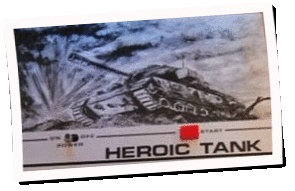 Tank Combat
El más conocido de los sistemas de juegos de tanques basados en el chip AY-3-8700-1 de General Instruments fue Coleco Telstar Combat. ver más
El más conocido de los sistemas de juegos de tanques basados en el chip AY-3-8700-1 de General Instruments fue Coleco Telstar Combat.
 Technigraph TV Sport
Technigraph TV Sport mark I
Technigraph TVG SD-1
 Tele Partner Giochi Televisivi green
 Tele-Match 4 4400
Tele-Match 4 6600
Tele-Match 4 7700
Tele-Match Television Computer Game 3300R
Tele-Play 8
Tele-Play 8C
TelePartner SD-02-3 TV-Tank-Battle
TelePartner TVG-SD-04
 Telegioca Match I
 Teleng Colourstars
Teleng Colourstars - England
Teleng Telestars
 Telespiel SP-501
no está identificado el fabricante la caja es como la del Gamatic 7600, pero las máquinas son diferentes ver más
no está identificado el fabricante la caja es como la del Gamatic 7600, pero las máquinas son diferentes
 Teletenis Compact
Teletenis Mini
 Temco T106C
Temco T802
Temco T802C
 Termbray TV Game
Termbray Video Game
Termbray Video Game TVG-204
 Texas Instrument TI-1050
 Texas Instruments SN 76410N
6 Ball Paddle variants ver más
6 Ball Paddle variants
 Thomson JV 1002
Thomson JV 402T
Thomson JV1T
Interton 2400 etiquetado para el mercado francés. ver más
Interton 2400 etiquetado para el mercado francés.
 Tokyo Colour 4
Tokyo Sportsman
 Tomy Blip
Tennis Tennis (mechanical) English The Digital Game. Uh-huh, yeah, right. A mechanical Pong-type game that was invented by Hikoo Usami … ver más
Tennis Tennis (mechanical) English The Digital Game. Uh-huh, yeah, right. A mechanical Pong-type game that was invented by Hikoo Usami (Tokyo). All of the game play is mechanical, powered by a wind-up timer mechanism. The batteries are only there to light up the single red LED light that represents the ball. You can actually play the game with no batteries in a bright enough setting. Its hard to believe that a game like Blip could captivate a generation, but it was high on many Christmas lists in 1977. The game was a simple electromechanical version of Atari Pong: an LED bounced back and forth across the court, powered by a windup timer. There is something incredibly ironic about a unit marketed as The Digital Game which makes a mechanical bZzzz... Bzzz... bzzz... noise as you play. The game is very simple, reset the score, and serve. The opponent need to guess where the ball is going to land, and need to press the correct button (1, 2 or 3) just before the ball arrived. The game play is really fun when playing with another player, against the computer is almost impossible to win , but it provide great training. TOMY sold many of these little portables, no doubt riding on the success of Ataris much more expensive electronic. Perhaps the real secret of Blips success was hidden in the tag line on the box: Take it anywhere. No TV set is needed. Parents probably envisioned a portable game as a great way to keep kids from taking over the living room TV set. TOMY´s Japanese version was called World Tennis ,French version was released by Meccatronic. It was also sold by PaliToy. All where produced in Japan. Blip was a hand-held electro-mechanical game marketed by Tomy starting in 1977. The game was a simulator of games like tennis, ping-pong, and Ataris video game Pong. Gameplay[edit] For a two-player game, the games selector switch was set to position 2 (for two players). The game was then turned on and the red LED ball lit up. Whichever side the ball was on served first. The servers score counter was set to 0 while the receivers counter was set to R. The timer was then turned. A push of the serve button began the game. The players must anticipate where the ball would land in one of three spaces on the playing field marked 1, 2, and 3. The player must then push the corresponding button before the ball lands on the space. If the player was successful in anticipating the balls space and pushed the button in time, the ball was then returned to the opposing player. If the player anticipated wrongly, the ball would stop and that player must then serve the ball, giving the opposing player 1 point. Game play continued until either the timer stopped or 10 points was earned by one of the players. Blip was also capable of being played by a single person when the selector switch was set to position 1. Development and history Blip was designed by Hikoo Usami for the Tomy Kogyo Co., the patent being filed in 1976 and awarded in 1977. The game was housed in a plastic case with a translucent screen. On the screen was a hash line dividing the screen in half (and simulating a net) and contained the three positions for the ball to land for both sides. The upper portion of the case also contained the 1, 2, and 3 position buttons, the serve buttons, the player selector, and the timer dial. The underside contained the wheels to turn the score counters and the battery compartment. It was the timer which provided the motor function to the game. Upon the timer dial being turned, this wound a spring which then, via several gears, drove the arm upon which the LED light (the ball) was mounted. Movement of the LED was ostensibly random but a player was capable of memorizing the movements of the LED and recognize patterns which would enable the player to better anticipate where the ball would land. Power for the LED was provided by two AA batteries. However, because the game was mechanical, in the right light conditions, it was possible to play Blip without batteries as one could see the unlit LED under the screen. Tomy marketed Blip in the U.S. starting in 1977 and it was a very popular game when it debuted, being one of the must have holiday gifts for the 1977 Christmas shopping season. In Japan, Blip was marketed as World Tennis and differed from the U.S. game by having the words World Tennis emblazoned on the screen and replacing the 1, 2, and 3 on the screen with silhouettes of tennis players. The Blip name remained on the Japanese version. In France, the game was marketed by Meccatronic. The German version was called Blip-o-Matic, although the Blip name remained on the case.
Tomy Blip french
 Tomy Pocket Game Gone Fishin
Tomy Pocket Game Poker Machine
Tomy Pocket Game Time Trap
Topaz TV Challenger Series 3000
 Toshiba TVG-610
 Trensi TV Color Sport TVG-406-6
 Trevi M1200 Micro Computer
Trimen Polijuegos
Tsukuda Bellcon
 Tv Fun 301
Tv Fun 401
Tv Fun 501
Tv Fun 601
Tv Fun 601 Brown
Tv Fun 602
Tv Fun 701
 Ultrasound TV-9010
Ultrasound TV-9010-C
 Unimex Mark III
Unimex Mark IV
Unimex Mark V
Unimex Mark V-B
Unimex Mark V-C
Unimex Mark VI
Unimex Mark VII
Unimex Mark VIII
 Unisonic Tournament 1000
Unisonic Tournament 2000
Unisonic Tournament T2501
 Unitrex Video-Action
Unitrex Video-Pro
Unitrex Video-Pro II
Universum Color Multi-Spiel 4004
Universum Color Multi-Spiel 4006
Página 5 de 22